Conflict of interest and the NDIS

A conflict of interest arises when a person or organisation takes advantage of their position for personal or corporate benefit. The conflict may be actual (because it occurs), potential (because it may or is likely to occur), or perceived (because people could or would think it is a conflict, even if it is not).

Within the NDIS, the issue can arise when a provider offers multiple supports. A support coordinator, for example, is required to provide advice that is unbiased and fair, in helping to connect participants with the supports they need. However, if the support coordinator’s organisation also delivers other supports, they may unintentionally influence a potentially vulnerable participant’s decision-making process in the selection of the providers of their supports.

In his recent review of the NDIS Act, David Tune AO PSM discussed the potential conflict of interest that arises when support coordinators are also the providers of other funded supports within the individual’s plan. He recommended that:

The NDIS rules [be] amended to outline circumstances in which it is not appropriate for the providers of Support Coordination to be the provider of any other funded supports in a participant’s plan, to protect participants from providers’ conflicts of interest.

The Tune Review found that in some cases, where the participant was receiving funded supports as well as support coordination, the coordinators only directed participants towards supports provided by their own organisation. This limits the individual’s freedom of choice and control over their funded supports.

It is important that participants receive transparent advice about support options available, and providers respect the participant’s rights to freedom of expression, self-determination and decision-making. The Review recommended that where possible, a person’s support coordination should be independent from other service provisions.

Support providers have an obligation to put processes in place to limit conflicts of interest where possible. We have developed several resources that organisations can use to assist with this. Our support coordination and plan management policy outlines how providers can reduce the risk of conflicts of interest by:

  • Maintaining a separation between the service delivery team and the support coordination team where possible;
  • Ensuring that information and records of supports participants have received remain confidential;
  • Ensuring that participants receive all the information regarding support options under the NDIS;
  • Ensuring that the individual is aware of their rights to choose support from a provider that is different to where their support coordinator or plan manager works.

You can access these policies in SPP’s Reading Room:

  • Policy: Support coordination and plan management
  • Policy: Conflict of interest NDIS

Our Policy: Specialist Disability Accommodation (SDA) also addresses conflict of interest in the SDA context.

Want to find out more?

To access these resources and hundreds of others in SPP, click the button to the right!

Preventing and responding to abuse

The Royal Commission into Aged Care Quality and Safety  hearings to date have highlighted that many older Australians experience serious instances of abuse and neglect. Similarly, people with a disability are 10 times more likely to experience violence than people without a disability, and the Royal Commission into Violence, Abuse, Neglect and Exploitation of People with Disability  has been established in response to the seriousness and prevalence of these incidents.

With these Royal Commissions bringing the issues of abuse and neglect to the fore, now is a landmark period for organisations to re-assess how they are protecting human rights within their operations.

It is paramount that organisations are working to prevent abuse wherever possible, and have effective policies and procedures in place to respond to instances of abuse.

Some important elements of preventing abuse include:

  • Policies and guidelines that protect an individual’s rights
  • Empowering the elderly and people with a disability
    • Informing them about the rights that they possess
    • Ensuring that clients feel respected and valued in the organisation
  • The organisational culture
    • Ensuring that the staff screening process is thorough
    • Ensuring that workers undertake training in abuse prevention and client rights
    • Ensuring that there is a positive culture of feedback and complaints, encouraging people to speak up

It is essential that in cases where incidents do occur, the organisation responds appropriately. We have developed some new resources to help organisations implement processes to prevent and respond appropriately to abuse.

Find our policy and information sheets in SPP’s Reading Room:

  • Policy: Safeguarding
  • Info: Safeguarding (Responding to Abuse)

Want to know more?

To access these resources and hundreds of others in SPP, click the button to the right!

Navigating the NDIS Worker Screening requirements

In order to ensure the safety of vulnerable people, the NDIS Quality and Safeguards Commission requires providers to ensure that staff, contractors and volunteers who work with people with disability are approved by a state authority.

Currently the Worker Screening requirements are under interim arrangements, meaning that the worker checks are managed at a state level until Federal arrangements come into force. In the meantime, providers are still required to satisfy some requirements imposed by the federally administered NDIS Quality and Safeguards Commission.

These requirements include:

  • Identifying and documenting which roles need checks
  • Ensuring all workers in the above roles have a state appropriate check
  • Specified record-keeping requirements.

The roles which workers will need checks for are called ‘risk-assessed roles’. These are roles in which the worker has more that incidental contact with a person with disability. In addition, ‘risk-assessed’ roles include ‘key personnel’ roles such as the CEO, other senior managers who are responsible for executive decisions of the organisation, and members of the organisation’s board of directors or governing body.

Providers may engage workers in risk-assessed roles before the worker has received a check, however there are additional requirements for providers who do so.

Our Worker Screening Resources

In response to the NDIS Worker Screening requirements we have developed several resources:

    • Policy template: Worker Screening (Disability);
    • Template: Risk Assessed Roles List;
    • Template: Risk Management Plan for Unscreened Workers;
    • Template: Worker Screening Register.

These resources will help to guide organisations through their obligations under the interim Worker Screening arrangements, as well as satisfy all of the Commission’s documentation requirements.

The policy template contains information regarding acceptable checks on a state by state basis, as per the interim arrangements. When the National Worker Screening database comes into force, the list of acceptable documents will change to those determined as appropriate by the NDIS Quality and Safeguards Commission.

The Worker Screening register is in SPP as a dynamic Risk & Compliance register, allowing you to attach documents and assign email reminders to help you keep track of workers’ screening checks all in the one place. There is also an excel version of the register.

Subscribers can download, edit and implement our Worker Screening resources by signing in to SPP. Organisations who are not subscribed can take out a free trial or click the button below to sign up.

Not ready for Worker Screening?

Sign up to SPP and let our Worker Screening resources guide you towards compliant processes!

Moving towards best practice in aged care

The Aged Care Quality Standards “focus on outcomes for consumers and reflect the level of care and services the community can expect from organisations that provide Commonwealth subsidised aged care services”.

To supplement the Aged Care Quality Standards, a number of aged care peak bodies have released detailed guidelines, standards or tools, to help providers better appreciate the needs of specific cohorts of consumers.  These resources can help providers to improve their current services, and develop best practices for the delivery of the most appropriate care to those cohorts.

Recent examples of these supplementary resources include: 

We have worked with each of the above groups to develop self-assessments that reflect the guidance and targeted outcomes of their resources. Our new best practice self-assessments are now available in a “Towards Best Practice” module in the ACSA Quality Portal.

Following the new best practice self-assessments can be a very effective way for providers to benchmark their current practices against the best practice guidelines, encourage discussion within teams and work groups, and then implement and track improvement steps over time.

Each self-assessment contains a number of helpful resource templates and hyperlinks to additional information, to help organisations improve their systems in areas where they may be lacking. As for all other self-assessments in the ACSA Quality Portal, quality improvement plans and self-assessment reports can be automatically generated.  

You can take a look at the new aged care best practice self-assessments by logging in to the ACSA Quality Portal, or just click the button below to create a new account.

Sign up for a free trial

You can see our Towards Best Practice modules and much more in the ACSA Quality Portal.

Minimising the use of restraints

Amendments have been made to the Quality of Care Principles 2014 (Cth) to minimise the use of chemical and physical restraints in residential care settings, and to include specific requirements of aged care providers in relation to their use.

Requirements of  providers include:

  •  thoroughly documenting any planned use of restraint in a client’s care plan,
  • obtaining client consent,
  • notifying a client’s representative, and
  • obtaining authorisation from an appropriate health professional.

Additionally, the Aged Care Legislation Amendment (Quality Indicator Program) Principles 2019 (Cth) – which took effect from 1 July 2019 – require that use of physical restraint in aged care facilities must be submitted and documented through the MyAged Care Portal. The Aged Care Quality Standards also require that clinical care is best practice and is supported by a clinical governance framework that minimises the use of restraint.

For these reasons, it is pivotal that organisations understand the regulatory requirements around the use of restraint. To assist organisations in this regard,  BNG has developed a policy which incorporates these regulatory requirements. 

Find our policy template on SPP, in the Reading Room:

  • Policy: Eliminating the Use of Restraints (Aged Care)

Updated whistleblower protection requirements

As of 1 July 2019, changes to the Corporations Act 2001 (Cth) have been in place, creating a new whistleblower protection regime in Australia.

These legislative changes have extended the definition of ‘protected disclosures’, ‘eligible whistleblowers’ and have generally created stronger protections for whistleblowers. There is also a new requirement that certain entities, including public companies,  must have a whistleblower policy that complies with the new section 1317AI of the Corporations Act 2001 (Cth), from 1 January 2020.

 ASIC have subsequently released a Regulatory Guide that gives guidance to all companies required to have a whistleblower policy. The Regulatory Guide sets out in detail all of the elements that must be in a compliant whistleblower policy.

ASIC have also announced that not-for-profits or charities with an annual revenue of less than $1 million will be exempt from the requirement to have a policy.

However, all companies, including those not required to have a whistleblowing policy, are still bound by the whistleblower protections in the Corporations ActEven if your organisation is not required to have one, it may still be appropriate to adopt a whistleblower policy, to ensure accountability and protect vulnerable persons within your organisation.

 BNG has developed a comprehensive policy template  which addresses all the required sections listed in ASIC’s regulatory guide.

Find our resources on SPP,  in the Reading Room:

  • Policy: Whistleblower Protection (public companies)
  • Information Sheet: Whistleblower Protection

Contact Us

Want to know more? Talk to our team.

Aged Care Mandatory Quality Indicator Program

Since July 1, 2019, all Commonwealth subsidised residential aged care services are required to submit data in accordance with the National Aged Care Mandatory Quality Indicator Program (ACQIP).

The first iteration of the ACQIP requires providers to submit data for each resident for three indicators:

  • Pressure injuries;
  • Use of physical restraint; and
  • Unplanned weight loss.

From July 1, 2021 the indicator program will also require providers to submit data for an additional two indicators:

  • Medication management; and
  • Falls and fractures.

Robust records of the above indicators helps providers to measure and monitor their quality outcomes, and gives residential aged care services the data they need to inform quality improvements to their service.

The ACQIP also helps providers compare their quality, safety and consumer outcomes with other residential aged care providers from all over the country. Evidence from quality indicator programs in Australia and abroad have shown that significant quality improvements are achieved following the implementation of quality indicator programs.

The final objective of the ACQIP is to give aged care consumers access to transparent, comparable information about quality to assist them in making informed decisions about their care.

For more information about the ACQIP, visit the Department of Health’s website.

How SPP can help you to comply with your data submission requirements

We recently created a workbook that will aggregate all the relevant data you are required to submit under the Aged Care Quality Indicator Program.

The workbook is available to all SPP subscribers upon request.

Below is a short video showing the workbook’s functions.

Need help meeting the requirements of the ACQIP?

Managing violence and aggression​

It is important that no matter the working environment, your organisation is prepared for when violent or aggressive incidents occur.

Managing violence and aggression is a multi-step process. It involves preventative measures such as risk identification and management, risk assessment, processes for responding to violent or aggressive behaviour, investigating incidents and the roles and responsibilities of workers, clients and management committees.

Workplace violence and aggression includes actions that could physically or psychologically harm another person, taking place in a service environment. This includes situations where workers or clients are threatened, attacked or physically assaulted in a service delivery setting.

To assist organisations to develop comprehensive processes to prevent and manage violence and aggression in the workplace, BNG has developed a  multi-step policy template.

The policy template includes organisational principles such as:

  • Deeming aggression and violence as unacceptable forms of behaviour
  • Not tolerating aggression and violent behaviours of staff, clients, volunteers
  • Recognising responsibility to ensure a safe environment;

The policy also addresses environmental risks such as ensuring ease of access and exit to and from buildings, as well as client and staff risks such as substance  abuse and dementia and delirium.

Find the following template in the SPP Reading Room:

  • Policy: Managing Violence and Aggression

Becoming a best practice child safe organisation

 The National Principles for Child Safe Organisations 2019 are based on the ten recommendations of the Royal Commission into Institutional Responses to Child Sexual Abuse. Collectively, the National Principles see a child safe organisation as one that:

  • adopts strategies and takes action to promote child wellbeing,
  • prevents harm to young people, and
  • creates a culture of child safeguarding.

We’ve developed a self-assessment tool for the  National Principles in our online Standards and Performance Pathways platform (SPP). The self-assessment tool:

  • helps organisations to understand and comply with the National Principles, and
  • provides a range of child safe policies and templates that can be downloaded and tailored to their specific organisation.


So what are the key elements of child safe  procedures?


Involve children in processes

 
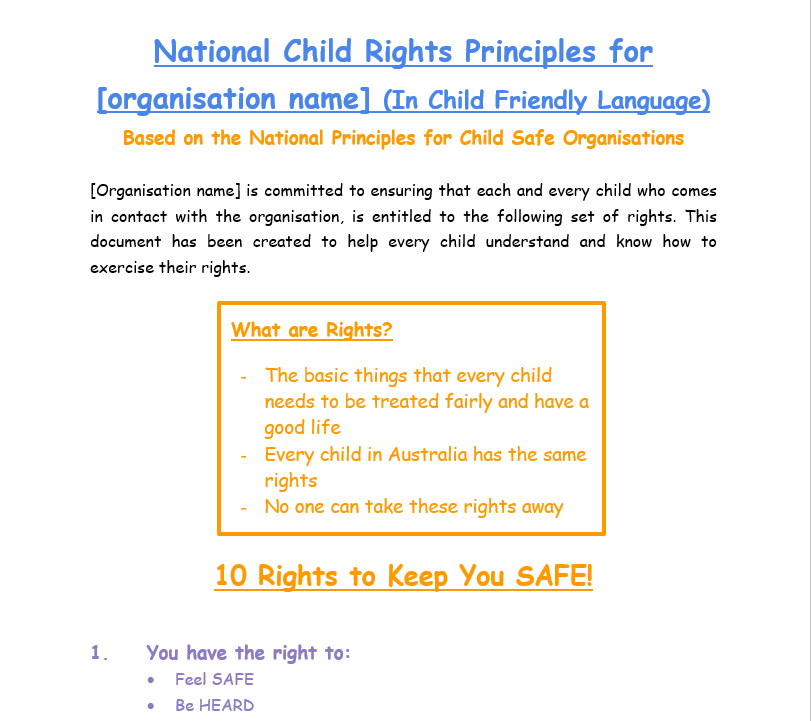
 A vital component of the child safety process is involving children in the development of your organisation’s child safe practices.  To assist you with this, we’ve have developed a ‘Child Rights’ Template in child friendly language. This will ensure that the children at your organisation are aware of what their rights are and how they can exercise them if they are threatened.


Child friendly english resource example.

Risk assessment

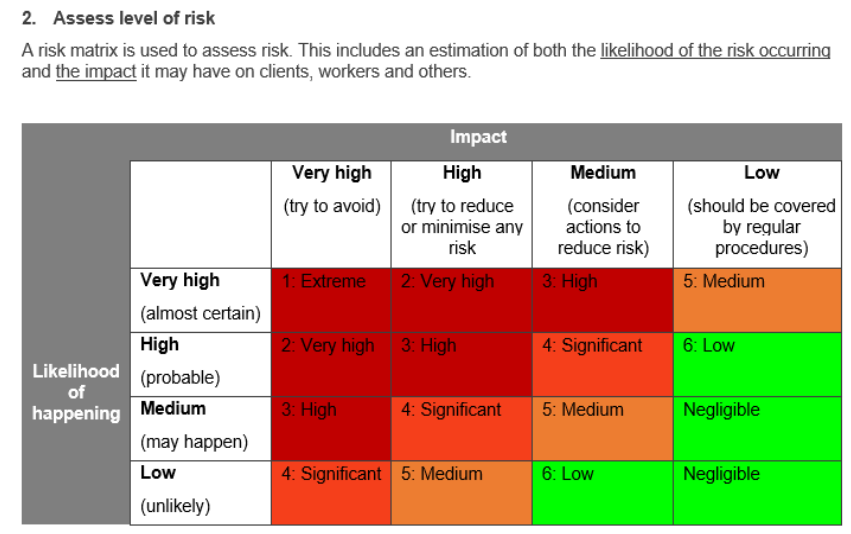
We’ve developed a Child Safe Risk Management policy, which outlines the principles of risk management in the context of child safety.  All people who interact with young children could pose some level of risk to them. But a considered risk assessment should also recognise the importance of not discouraging positive relationships between adults and children.

Risk assessment table example.

The Risk Management policy  details the roles and responsibilities of stakeholders, and child-specific key considerations such as supervision, physical contact and behavioural management.


Complaints management

The National Principles include a requirement that ‘processes for complaints and concerns are child focused.’ To help organisations develop effective complaints processes, we’ve developed a Child Safe Complaints Management Policy, which details the processes and procedures organisations should follow to implement an effective child-friendly complaints management policy. It also includes the important requirement that workers be trained in identifying signs of trauma in children such as increased tension, irritability reduced eye contact and an inability to relax.


Equity and inclusion

Another key element is ensuring that every child receives fair and equal treatment, regardless of their background. To support organisations achieve this, we’ve developed a Policy on Equity and Inclusion for Children and Young People.

Child with mirror.

Need help on your journey to best practice?