The new National Safety and Quality Primary and Community Healthcare Standards

The Australian Commission on Quality and Safety in Healthcare (the Commission) has recently published a new set of standards, the National Safety and Quality Primary and Community Healthcare Standards (the PCH Standards). These are a nationally consistent, consumer-centred set of safety and quality standards.

Who are these standards for and what do you need to know? Read on to find out more.

Who should follow the Primary and Community Healthcare Standards?

The Commission will be encouraging all Australian primary and community healthcare services that are directly involved in patient care to implement the PCH Standards.

The PCH Standards are applicable to services that deliver health care in a primary and/or community setting. These services address the prevention, treatment and management of illness and injury, and the preservation of physical and mental wellbeing. This includes health providers like dentists, physiotherapists, podiatrists, speech pathologists and other allied health providers.

What do the Primary and Community Standards require?

There are three Primary and Community Healthcare Standards that cover clinical governance, partnering with consumers and clinical safety.

  • Clinical Governance Standard, where clinical governance is the set of relationships and responsibilities established by a health service to ensure good clinical outcomes. It ensures that the community and healthcare services can be confident that systems are in place to deliver safe and high-quality health care, and continuously improve services.
  • Partnering with Consumers Standard, which describes the systems and strategies to create a person-centred healthcare service in which patients and consumers are:
    • Included in shared decision-making
    • Partners in their own health care
    • Involved in the development and design of quality healthcare services.
  • Clinical Safety Standard, which considers specific high-risk areas of health care commonly encountered that need to be addressed and mitigated.

Are the Primary and Community Healthcare Standards mandatory?

The PCH Standards are voluntary. They should only be applied where services are involved in the direct care of patients.

However, in some cases, accreditation against the Standards may be required by a funder of a healthcare service to satisfy regulatory or contractual obligations.

How do these standards fit in with other safety and quality standards developed by the Commission?

The Commission has developed a range of safety and quality standards, including:

  • National Safety and Quality Health Service Standards
  • National Safety and Quality Digital Mental Health Standards
  • National Safety and Quality Mental Health Standards for Community Managed Organisations (in development)

All safety and quality standards developed by the Commission are aligned in structure and intent, and focus on embedding clinical governance and consumer partnerships in safe, high-quality healthcare services.

If no standard is mandated, then a healthcare service may choose to implement the standard that is most applicable to their service context.

Primary and community services can be subject to multiple sets of standards.  The Commission intends that the PCH Standards “are used as the core safety and quality component of each set of standards, thus minimising the compliance burden across multiple sets of standards”.

Can I transition from NSQHS to the Primary and Community Healthcare Standards?

If a service is currently accredited to NSQHS on a voluntary basis, it can transition to the PCH Standards once accreditation becomes available, at time of reaccreditation.

If a service is accredited to NSQHS as part of regulatory or contractual requirements, for example, a Local Health Network, you will need to check with your regulator and/or funder.

How can I get accredited for the Primary and Community Healthcare Standards?

The Commission is developing an assessment model for healthcare services to become accredited under the Australian Health Service Safety and Quality Accreditation (AHSSQA) Scheme. It is anticipated that accreditation will become available from mid-2022.

In advance of formal accreditation, a self-assessment module for the Standards is already available on SPP. Our self-assessment module is an excellent way to familiarise yourself with, and work your way through the requirements of, the PCH Standards. The self-assessment also includes links throughout to a number of relevant resources and templates.

Further information

You can access more information from the Commission about the National Safety and Quality Primary and Community Healthcare Standards here.

Interested in the PCH Standards?

Access self-assessments for the Primary and Community Healthcare Standards on SPP.

The new NDIS Practice Standards are here! What now?

We have been waiting on the release of an update to the NDIS Practice Standards for a little while now, and as of November 2021 the NDIS Commission has provided details of key amendments. Read on to get our rundown on all the changes.

What are the key changes?

The most significant change brought in by these amendments is the introduction of the following three new NDIS Practice Standards:

In Core Module Standard 2 (Governance and Operational Management):

  • Emergency and disaster management – This standard addresses the planning required by providers to prepare, prevent, manage and respond to emergency and disaster situations whilst mitigating risks to, and ensuring continuity of, supports that are critical to the health, safety and wellbeing of participants. Note that this practice standard specifically highlights the responsibilities of a provider’s governing body in this area.

In Core Module Standard 4 (Support Provision Environment):

  • Mealtime management – This practice standard applies to providers of supports to participants who require assistance to manage their mealtimes, including those with mild dysphagia. The standard deals with the nutritional value and texture of meals, and concerns the planning, preparation and delivery of meals. The standard aims to ensure quality and safety of mealtime management. 

In Module 1: High Intensity Daily Personal Activities

  • Severe dysphagia management – This practice standard applies to providers registered to provide high intensity daily personal activities and who have severe dysphagia management set out in their certificate of registration. Providers will be required to ensure that participants with severe dysphagia receive support that is relevant and appropriate to their specific needs and circumstances.

Quite a number of other new and amended Quality Indicators

There are also a number of new and amended Quality Indicators throughout the Practice Standards. Providers should familiarise themselves with all of these changes as soon as possible.

Many of the new or amended indicators relate to emergency and disaster management, including infection outbreaks, and the associated necessary worker training and capabilities.  However, there are also other amendments in areas such as:

  • the consideration of preventative health measures in planning supports, where relevant; and
  • more prescriptive requirements in relation to participant risk assessments, and their regular review.

The new and amended Quality Indicators appear in the following Practice Standards:

Core Module

Standard 2: 
  • Risk Management
  • Human Resource Management
  • Continuity of Supports
Standard 3: 
  • Support Planning
  • Service Agreements with Participants
  • Responsive Support Provision
  • Transitions to or from a provider (Previously Transitions to or from the provider)
Standard 4:
  • Safe Environment
  • Management of Waste

Module 3: Early Childhood Supports

  • The Child

Verification Module

  • Human Resource Management
  • Risk Management

When do the changes come into effect?

  • 15 November 2021: for registered NDIS providers, the new severe dysphagia management practice standard, together with all of the new and amended quality indicators we’ve mentioned above, are applicable from this date.
  • 13 December 2021: the mealtime management practice standard is subject to a transition period and comes into effect from this date. 
  • 24 January 2022: the emergency and disaster management practice standard is subject to a transition period and comes into effect from this date. 

Updated and new SPP self-assessments will be available shortly!

We’ve been working hard to update our SPP self-assessments for the NDIS Practice Standards as soon as possible, to help you get on top of the new requirements and streamline your compliance work.

We expect to be releasing updated self-assessments within the next couple of weeks.

We will also be making available a new “educative” self-assessment for the NDIS Practice Standards, as well as a new module to help board and governing body members better understand their responsibilities under the Practice Standards, and hopefully enhance their engagement with management.

So watch this space!

Further information

An updated version of the NDIS Practice Standards has been published here.

If you would also like to read the legislative amendments in full, you can access those here and here.

Want to manage NDIS compliance simply?

Access self-assessments for the NDIS Practice Standards on the NDS Quality Portal.

Changes to child safe legislation in NSW: what you need to know

The Children’s Guardian Amendment (Child Safe Scheme) Bill 2021 has just been passed in NSW Parliament. This new Bill amends the Children’s Guardian Act to embed the NSW Child Safe Standards as the primary framework guiding child safe practices in NSW.

The requirements for specified ‘child safe organisations’ outlined in this blog post will become mandatory from 1 February 2022. 

This Bill is an amendment of an earlier Exposure Draft, released in 2020. A breakdown of the key changes from the the original Exposure Draft, can be found in the Consultation Summary.

Who is a child safe organisation?

So, who is a child safe organisation for the purposes of this legislation? Well, this new Bill features an updated definition of child safe organisation‘, which now covers the following: 

  • entities mentioned in Schedule 1 of the Children’s Guardian Act (excluding designated agencies and adoption service providers),
  • religious bodies that provide services to children, or in which adults have contact with children,
  • local government authorities, and
  • clubs or other bodies providing recreational or sporting programs or services to children, and in which workers are required to hold a working with children check clearance.
Notably, religious bodies and sport and recreation organisations are new groups on this list. The Office of the Children’s Guardian (OCG) has acknowledged that there are still some organisations who work with children who are not included in this list. While some organisations are not currently in scope, the Child Safe Standards can be implemented by all child-related organisations and will remain voluntary for organisations outside scope.

It’s important to note that designated agencies and statutory out-of-home care and/or adoption services have been specifically excluded from the Child Safe Scheme. This is because they are already subject to regulation by the OCG under the Child Safe Standards for Permanent Care (currently under review).

Special responsibilities and liabilities are held by the ‘head of a child safe organisation’. The Bill defines ‘head of a child safe organisation’ as:

  • the person or class of persons prescribed by the regulations, if the regulations prescribe such a person,

otherwise

  • the chief executive officer of the organisation, however described,
  • if there is no chief executive officer—the principal officer of the organisation, however described, or
  • if there is no chief executive officer or principal officer—a person who has been nominated by the organisation and approved by the Children’s Guardian under the Children’s Guardian Act (s66).

What do child safe organisations have to do?

The ‘head of a child safe organisation’ must implement the Child Safe Standards through systems, policies and processes including the following:

  • a statement of the organisation’s commitment to child safety,
  • a child safe policy,
  • a code of conduct that applies to employees, management, contractors and volunteers,
  • a complaint management policy and procedure,
  • a human resources policy, and
  • a risk management plan.

The head of a child safe organisation must ensure the organisation implements a reportable conduct policy.

Additionally, the head of a child safe organisation is responsible for ensuring systems, policies and processes are continuously reviewed and updated to reflect any changes to the Child Safe Standards.

It is clear that organisations must be aware of who their ‘head’ is, as responsibility for implementation and monitoring of the Child Safe Standards lies with them. 

Monitoring and investigation

The Bill provides the Children’s Guardian with powers to monitor the implementation of the Child Safe Standards. The Children’s Guardian may monitor any child safe organisation through the following measures:

  • review the organisation’s systems, processes and policies,
  • review information held by the Children’s Guardian about the organisation and its employees,
  • with the consent of the head of the organisation, have an authorised person inspect the organisation’s premises, and
  • direct the head of the organisation to complete a self-assessment of the organisation’s compliance with the Child Safe Standards (a mandatory direction).

The Children’s Guardian may, at any time (by written notice) require the head of a child safe organisation to provide information about the organisation’s systems, policies and processes.

If the organisation does not provide the requested information, the Children’s Guardian may commence an investigation , and publish the organisation’s details on the Office of the Children’s Guardian’s website.

The Bill also provides the Children’s Guardian with powers for the investigation of complaints and concerns about a child safe organisation’s implementation of the Child Safe Standards. The Children’s Guardian may commence an investigation if:

  • a complaint is received about an organisation,
  • the organisation fails to respond to a recommendation made by the Children’s Guardian in a monitoring assessment report, or
  • for any other reason, the Children’s Guardian is concerned the organisation is not implementing the Child Safe Standards.

When conducting an investigation, the Children’s Guardian may follow any of the same steps as described earlier in relation to monitoring. It may also conduct an inquiry.

At the end of an investigation, the Children’s Guardian will prepare a report for the organisations, which will include recommendations for improvements, and may include enforcement measures.

How will the Child Safe Standards be enforced?

The Bill provides for enforcement measures, which allow the Children’s Guardian to issue compliance notices and to enter into enforceable undertakings with child safe organisations.

A compliance notice will be in writing and will include:

  • reasons for the belief the organisation is not implementing the Child Safe Standards,
  • risks to children that arise as result of the non-compliance,
  • the action the organisation is required to take,
  • the period of time within which action must be taken, and
  • a statement that failure to comply with the notice is an offence.

There are also provisions for organisations to request an internal review or extension of time in relation to a compliance notice.

A list of compliance notices currently in effect will be made available on the OCG’s website.

There are penalties associated with failure to comply with a compliance notice – 250 penalty units for a corporation, and 50 penalty units for others.

Instead of issuing a compliance notice, the Children’s Guardian may accept an enforceable undertaking from a child safe organisation, which is an undertaking from the organisation under which the organisation agrees to take specific action by a specific date. A list of enforceable undertakings that are in effect will also be made available on the OCG’s website.

The OCG has expressed its intention to use a ‘light touch’ in its approach to regulation, focusing on education and building on organisations’ existing strengths. However, these enforcement measures will be exercised in some cases, where necessary to ensure the safety, welfare and wellbeing of children. 

Capability building

The Bill sets out the Children Guardian’s responsibility to work collaboratively with child safe organisations to build capacity for child safe practice.

These provisions indicate that the Children’s Guardian may develop further guidelines to assist organisations and the broader community to implement the Child Safe Standards. If any such guidelines are developed, they will be published on the OCG’s website, and may include templates that can be used by child safe organisations.

The Bill specifies that the Children’s Guardian may provide training on the implementation of the Child Safe Standards, and that it may charge fees to cover any reasonable costs of the training.

Additional changes

The Bill includes a requirement for prescribed agencies to develop a ‘child safe action plan’. This requirement will not apply to community-based organisations in NSW, as it is limited to significant public sector departments, offices and agencies.

The Bill also includes an information sharing provision, which allows the Children’s Guardian to share information with other States/Territories or the Commonwealth, where a matter has relevance to another jurisdiction.

Access the Child Safe Standards on SPP

Sign up for a free trial now to self-assess against the NSW Child Safe Standards in the SPP platform. 

Is your aged care board equipped to govern successfully?

Quality services arise from good leadership. As an aged care provider, your governing body plays an integral role in promoting a culture of safe, inclusive and quality care and services, and overseeing your organisation’s operations.

Responsibilities

Under the Aged Care Quality Standards, the governing body is accountable for the delivery of safe and high quality care and services to all consumers in the organisation’s care. 

Each member of the governing body must be satisfied that the organisation has in place the culture, strategies, policies, practices and behaviours to ensure delivery of care and services to that standard.

Challenges for non-executives

But boards are usually (and should be!) composed of non-executive directors, who very often will be fulfilling their role on a voluntary basis.  On any one board there may be directors with varying levels of knowledge about the specific requirements of the Aged Care Quality Standards.  Directors may be located remotely from the provider and, especially over the last 18 months with COVID, opportunities for face to face on site meetings has been extremely limited.

And yet, individually, each director shares the responsibility to oversee that their provider delivers safe, quality and compliant care.

Problems highlighted by the Royal Commission

The importance of strong governance in aged care was a central finding of the recent Royal Commission into Aged Care Quality and Safety. In their Final Report, Commissioners Pagone and Briggs were blunt in their assessment of the failures of some aged care providers’ governing bodies:

“Provider governance and management directly impact on all aspects of aged care. Deficiencies in the governance and leadership of some approved providers have resulted in shortfalls in the quality and safety of care. Some boards and governing bodies lack professional knowledge about the delivery of aged care, including clinical expertise. There is a risk that they may focus on financial risks and performance, without a commensurate focus on the quality and safety of care.”

The Commissioners spoke unambiguously of the duty held by governing body members:

“Accountability begins and ends with the leaders of an organisation, the board and senior management. If boards and governing bodies do not have the knowledge or skills to understand the care that is being delivered, they are unable to ensure that this care is high quality and safe. The values and behaviour of people in these senior positions have a significant impact on workplace culture and the quality of care that is delivered.”

It is clear that scrutiny of aged care provider governing bodies will be a focus of the Aged Care Quality and Safety Commission – now and into the future. Already, government has begun legislating for greater accountability and responsibilities for governing bodies, with the recent Aged Care and Other Legislation Amendment (Royal Commission Response No. 2) Bill 2021 signalling strengthened governance arrangements from March 2022.

Now, more than ever, providers must ensure that their governing bodies are highly informed, involved, and are advocates for quality and safety in the aged care sector.

Our solution: the Board Governance Toolkit

In response to the findings of the Royal Commission, and requests from our customers, we have developed the Board Governance Toolkit.

Our new Board Governance Toolkit addresses all of the requirements in the Aged Care Quality Standards for oversight of the organisation’s provision of quality and safe care and services, and oversight of management and staff.

For each requirement, we ask a series of questions that walk directors through the necessary avenues of enquiry, so that they understand their obligations and are guided to ask the right questions and receive the correct and relevant information from management. Directors also have the opportunity to comment on how their organisation is meeting that requirement, or how it could improve.

Our Toolkit helps each individual board member to:

  • Understand their ACQS responsibilities
  • Record their assessment of organisational performance
  • Engage effectively with senior management
  • Identify gaps and areas for improvement
  • Regularly review progress and update priorities

Our Toolkit facilitates regular review and continuous quality improvement.  As part of regular quality improvement processes, governing body members should revisit the Toolkit and update their comments, for review and discussion at board level on a regular basis.

Click here to view our Board Governance Toolkit flyer.

Seeking guidance for your board?

Access the Board Governance Toolkit on SPP.

An update on the Child Safe Standards in Victoria

In March this year, we wrote a blog post which looked at where each state or territory was at with their implementation of the Child Safe Standards. Since then, there have been significant updates in Victoria. Last month, the Commission for Children and Young People in Victoria (the Commission) released the new Child Safe Standards, which aim to “provide more clarity for organisations and are more consistent with Standards in the rest of Australia”.

Do the new Standards apply to my organisation?

To find out if your organisation has to comply with the Child Safe Standards in Victoria, click here. And if you have additional questions around the new Victorian Child Safe Standards, their frequently asked questions page is a good place to start!

When do the new Standards commence?

The Standards will come into effect in Victoria on the 1st of July 2022. The Commission has recommended that organisations start thinking about meeting the new Standards and review their current approach to child safety, to plan what they need to do to comply with the new Standards.

The Commission has said that if organisations choose to meet the Standards before the 1st of July 2022, they will be accepted as compliant by the Commission.

How do the new Standards differ from the National Principles?

The Victorian Child Safe Standards closely align with the National Principles for Child Safe Organisations (the National Principles).  However, there is one additional Standard (Standard 1) on cultural safety for Aboriginal children and young people, and two additional indicators in Standard 3 around empowering children and young people. Given that the Victorian Standards differ slightly from the National Principles, some organisations who work nationally or across state borders will need to comply with both sets of Standards.  

How can SPP help me to meet the new Standards?

The good news is that SPP can assist Victorian providers to meet not just the Victorian Child Safe Standards but also Child Safe Standards across other jurisdictions. Last month, following the release of the Victorian Child Safe Standards, we added a self-assessment into the platform to assist providers to meet their new requirements. We have previously added self-assessments into SPP for both the NSW Child Safe Standards and the National Principles.

Our new Victorian Child Safe self-assessment is cross-mapped to other child safe standards on our platform, meaning that your answers will carry across from one set of standards to another, where there are common or duplicated requirements. So, if you self-assess against the Victorian Child Safe Standards, you will simultaneously be making progress against the National Principles and the NSW Child Safe Standards.

The self-assessment will assist organisations to identify any gaps or areas for quality improvement.  It also provides a range of child safe templates that providers can download and tailor to their needs.  

You can find the new self-assessment for the Victorian Child Safe Standards under the Standards tab > Australian National Standards.

Want to learn more?

For more information about the child safe self-assessments and resources on our platform, sign up for a free trial!

New key standards for the digital mental health space

The National Safety and Quality Digital Mental Health (NSQDMH) Standards were released in November 2020, and are the first of their kind. Developed by the Australian Commission on Safety and Quality in Health Care in consultation with consumers, service providers, academics, regulators and technical experts, the NSQDMH Standards aim to improve the quality of digital mental health service provision, and protect service users and their support people from harm.

What is a digital mental health service?

In the current context of the COVID-19 pandemic, coupled with the rapid evolution of digital technologies, telehealth services are being used more widely than ever before. As the take-up of these digital services increases, it makes sense to improve the regulation of the digital health service provision space.

So what does a digital mental health service look like?

The NSQDMH Standards define digital mental health as a mental health, suicide prevention or alcohol and other drug (AOD) service that uses technology to facilitate engagement and deliver care. Traditionally mental health, suicide prevention and AOD were considered distinct sectors, however the NSQDMH Standards refer to these digital services collectively.

Digital mental health services include:

  • Services that provide information
  • Digital counselling services
  • Treatment services (including assessment, triage and referral services)
  • Peer-to-peer support services

Digital mental health services may be delivered by:

  • Telephone (including mobile phone)
  • Videoconferences
  • Online services (such as web chats)
  • SMS
  • Mobile health applications (apps)

What are the National Safety and Quality Digital Mental Health Standards?

The three NSQDMH Standards are:

  • Clinical and Technical Governance Standard
  • Partnering with Consumers Standard
  • Model of Care Standard

The three standards include 59 actions related to clinical and technical aspects of digital mental health services. They describe the level of care and the safeguards that a digital mental health service should provide.

The NSQDMH Standards create a nationally consistent quality assurance mechanism for digital mental health service providers. Providers can assess areas of compliance as well as areas for improvement, with respect to their safety and quality assurance systems.

The standards are modelled on the National Safety and Quality Health Service Standards (NSQHS). Providers who already meet NSQHS are only required to implement actions specific to the NSQDMH Standards, which are relevant to their service.

Implementation of the NSQDMH Standards is currently voluntary. Self-assessing against the standards is an excellent way for service providers to demonstrate best practice in this space.

To assist providers to learn more about these standards and measure themselves against them, we are pleased to offer a self-assessment for the NSQDMH Standards on SPP. Our self-assessment consists of quizzes for each action across the three standards, as well Evidence Guides and linked resources to accompany each quiz.

You can find the self-assessment for the National Safety and Quality Digital Mental Health Standards in SPP under the Standards tab > Australian National Standards.

Want to learn more?

Self- assess against the National Safety and Quality Digital Mental Health Standards on SPP.

New rules for restrictive practices in aged care

The Australian Government has recently introduced measures to strengthen the regulation of restrictive practices (formerly known as restraints) in residential aged care settings. As of 1 July 2021, key definitions and processes regarding the regulation of restrictive practices in residential aged care have changed.

These changes reflect increased regulation over the area of restrictive practices, greater alignment with the regulations of the National Disability Insurance Scheme (NDIS), and an increased focus on informed consent.

The Aged Care Quality and Safety Commission’s Regulatory Bulletin lays out these changes in greater detail.

Changes from 1 July 2021

The changes are contained in legislative amendments to the Aged Care Act 1997 and Quality of Care Principles 2014, which came into effect on 1 July 2021. They clarify the limited circumstances in which restrictive practices can be used in relation to a care recipient.

The definition of restrictive practices has been changed to include chemical restraint, environmental restraint, mechanical restraint, physical restraint and seclusion.

Use permitted only in limited circumstances, and where specific requirements are met 

Updates to the Quality of Care Principles have changed the circumstances in which restrictive practices can be used, which must be:

  • Only as a last resort to prevent harm;
  • After consideration of the impact of the practice;
  • After best practice alternative strategies have been considered, used and documented;
  • Only to the extent necessary, and in a proportionate manner;
  • In the least restrictive form, and for the shortest time;
  • Where informed consent is given; and
  • In accordance with the care recipient’s care plan, the Aged Care Quality Standards, and the Charter of Aged Care Rights.

Specific requirements have been imposed separately for the use of chemical restraints.

While the restrictive practices are being used, the provider must regularly monitor the care recipient for signs of distress or harm, side effects and adverse events, changes in wellbeing, as well as independent functions or ability to undertake activities of daily living.

Emergency use

The Quality of Care Principles permit the temporary use of restrictive practices in the event of an emergency. In that situation, some of the specific use requirements, including the requirement to obtain consent, do not need to be met. This exemption from the requirements is to allow a provider to respond quickly to ensure the protection of a care recipient or other person from immediate harm. An emergency is a serious or dangerous, unforeseen situation which requires immediate action.

Following the emergency use of a restrictive practice, the provider is required to:

  • Inform the care recipient’s restrictive practices substitute decision maker about the use of the restrictive practice, and document whether this occurred;
  • Obtain consent for the restrictive practice and record as soon as practical; and
  • Once the emergency is over, revert to the usual policies and procedures regarding the application or use of any restrictive practice for the care recipient. This includes documenting the use and consideration of alternative strategies.

Reporting on the use of physical restraint has also been revised with the publication of the National Aged Care Mandatory Quality Indicator Program Manual – 2.0, which also applies from 1 July 2021.

The updated manual states, “For the purposes of the QI Program, physical restraint includes all forms of restrictive practice, excluding chemical restraint.” This means that the quality indicator for physical restraint now includes physical restraint, mechanical restraint, environmental restraint and seclusion.

In line with these reforms, we have updated our Use of Restrictive Practices Aged Care Policy, which aligns with the revised legislation, and with the new QI Program Manual, and includes the following:

  • Change in terminology from “restraints” to “restrictive practices”. This new term is used to describe all forms of “restraint”.
  • Changes to the types and definitions of restrictive practices that may be used. These definitions include chemical restraint, environmental restraint, mechanical restraint, physical restraint, and seclusion.
  • Clarification of existing processes that just be followed regarding consent, monitoring and evaluation, and requiring that any restrictive practice is used as a last resort.
  • Revised definition of “physical restraint” for purpose of recording and reporting data for the National Aged Care Mandatory Quality Indicator Program.

Our policy will help providers and their staff ensure the correct process is followed in relation to use of restrictive practices, and to record and report physical restraint in accordance with the National Aged Care Mandatory Quality Indicator Program.

This resource can be found in the Reading Room by searching “use of restrictive practices”.

Changes from 1 September 2021

Further amendments will commence from 1 September 2021, requiring providers to comply with responsibilities relating to behaviour support plans.

This includes a new requirement for providers to have a behaviour support plan in place for any care recipient who has restrictive practices used as part of their care.

Behaviour support plans will have to include:

  • Alternative strategies for addressing behaviours of concern;
  • Any restrictive practices which are used or applied once alternative strategies have been tried; and
  • Additional key information if the practice is used, and if its use is ongoing.

There will also be new obligations for reviewing, revising and consulting in relation to behaviour support plans.

As these amendments are not yet applicable, we have not yet included them in our updated policy. We will revise our policy again in advance of these changes.

Find key restrictive practices resources on SPP

Access our Use of Restrictive Practices (Aged Care) Policy in the SPP Reading Room.

Incident Management – the key elements for best practice

Incident management in Aged Care now aligned with NDIS

With the recent updates to the aged care Serious Incident Response Scheme (SIRS), including a new indicator being added to the Aged Care Quality Standards, the requirements for incident management in aged care have become more closely aligned with those under the NDIS Practice Standards.   

Given these developments, we thought it would be timely to take a look at what a best practice incident management system looks like.  

So, what does “incident management” involve?

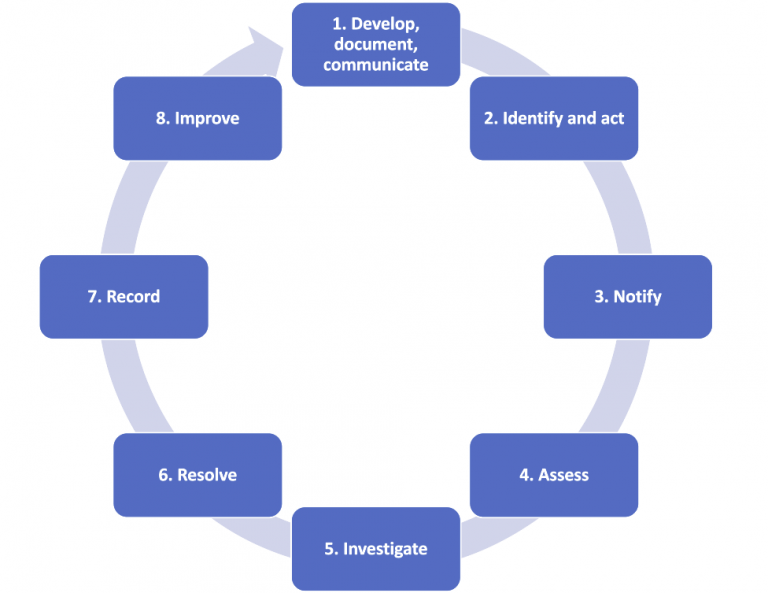
The overall goal of an incident management system is to reduce the risk of harm to clients, workers and the community. Incident management is an ongoing process that needs to be integrated into your quality improvement processes.  It begins with documenting and communicating your approach; requires that all workers follow a consistent process to respond to and resolve the incident; and concludes with a review, learning and improvement process, to minimise the likelihood of the incident re-occurring.   

A best practice incident management cycle

Documenting the process

To ensure that all workers know what to do when it comes to incidents, your incident management system should be clearly documented, with policies and procedures that are easily accessible to the workforce. 

Communication and training

It is important that workers receive training related to incidents, so that they understand the organisation’s incident management procedures, and how to respond if they witness or hear about an incident.  

The training should be included in your induction processes, as well as on an ongoing basis.  Workers need to know how to identify incidents, even low-risk incidents, so that they are able to respond to the incident accordingly. And they should understand the procedures to follow, and which staff members to inform, immediately after an incident occurs.  

You should have a clear definition of which occurrences (including acts and omissions) constitute an incident. This will help to streamline your response to incidents, ensuring that all incidents that occur in connection with service delivery are quickly identified and resolved.  

You should also have a priority rating system for incidents. This will help to categorise the severity of each incident and respond accordingly. The Aged Care Serious Incident Response Scheme (SIRS), for example, has an in-built priority system where incidents are given a rating of Priority 1 or Priority 2 depending on their severity. 

Managing an incident

Identification and response

Immediately following an incident, the primary goal is to ensure the safety of the client and the community. For serious incidents it may be necessary to contact emergency services.  

Even minor incidents must still be treated seriously, and be responded to in accordance with the organisation’s incident management processes. Minor incidents can have serious implications for clients and the organisation’s processes. 

Notification procedures

After an incident occurs, workers should notify senior management of its occurrence, so that senior management can determine what the next steps should be. This may include notifying families/guardians/advocates of the incident as a first step.  

Aged care, disability and/or child services providers are required to notify the relevant government entity of serious incidents which have occurred in connection with service delivery.  

For both aged care and disability providers, it is a requirement that a staff member within the organisation has the designated responsibility of notifying the relevant Commission within a particular timeframe, in an approved format. 

Assessment and investigation

Following an incident, the organisation should ensure that the incident is assessed to understand its severity and determine whether a formal internal investigation is required. 

If the incident is serious, the organisation should conduct a formal investigation to determine: 

  • The cause of the incident, 
  • The effect of the incident, 
  • Any organisational processes that contributed to or did not function in preventing the incident, 
  • Changes the organisation can make to prevent further incidents from occurring, 
  • What, if any, remedial action must be undertaken to prevent or minimise future incidents, and 
  • The effectiveness of the organisation’s incident management system in relation to the incident. 

Supporting those affected

The organisation must support the people involved in the incident, whether they are a client, a worker or a community member. This may include reassuring clients, providing access to professional counselling or trauma services, or changes to services. 

Keeping people affected by an incident informed of the response and resolution progress is central to the incident management process. Incidents should be managed in accordance with the principles of open disclosure 

Resolution

In some cases it may be necessary to take remedial action following an incident. Remedial action can range from providing a formal apology to providing financial compensation. You should involve those affected in the resolution of an incident, to ensure that all parties are satisfied with the outcome of the incident management process.  

Record-keeping and improvement

Recording

Record-keeping is central to the process of incident management and resolution. Record-keeping is a requirement for aged care, disability and child service providers. Accurate and detailed records are an important part of the continuous improvement aspect of managing incidents. 

Continuous Improvement

Each incident is a learning opportunity, and should be viewed as such. During the assessment and investigation stage of each incident, you should examine your processes to determine if any organisational processes failed and are in need of review. You should regularly review your incident register to identify trends, and address processes which may need revision. 

The goal: incident prevention

Overall, it is important that workers and organisations understand that the ultimate goal of an incident management system isn’t just to reduce the risk associated with incidents, but to prevent them altogether.  

BNG resources

We have quite a number of resources which will help you to develop your incident management processes in line with best practice: 

  • Policy: Incident Management and Procedures 
  • Policy: Incident Management Procedures (Aged Care SIRS) 
  • Policy: Open Disclosure
  • Template: Incident Register 
  • Template: Incident Register (Aged Care SIRS) 
  • Template: Incident Report Template 
  • Template: Incident Report Template (Aged Care SIRS) 
  • Template: Incident Investigation Template 
  • Template: Incident Investigation Template (Aged Care SIRS) 

Additionally, organisations should follow the incident management guidelines of the relevant Commission. For aged care or disability providers, click the links below: 

Help with incident management

Looking to refine your incident management system? Log in to SPP to see pur resources in the Reading Room.

Advance care planning: the role aged care providers should play

Advance care planning is a process of planning for future health and personal care, which enables a person to set out their values, beliefs and preferences.

The Royal Commission into Aged Care Quality and Safety identified the making and updating of advance care plans as a priority issue in reforms to aged care. The Commission found that providers should be required to assist people receiving care to make and update an advance care plan, if they wished to, and to ensure that these plans are followed. The Commission also recommended that residential aged care providers should be required to provide any advance care directives to paramedics, if a resident is being transferred to hospital via ambulance.

In its response, the Government indicated that periodic reviews of the Aged Care Quality Standards would include consideration of priority issues, including advance care planning. The Government also committed to additional funding to improve transitions of aged care residents between aged care and health care systems.

With this indication that regulations around advance care planning may be strengthened in the future, providers can demonstrate best practice by developing robust policies and processes for advance care planning. 

Advance care planning and the Aged Care Quality Standards

Advance care planning does already feature in the Aged Care Quality Standards (ACQS), Standard 2 – Ongoing assessment and planning with consumers.

Standard 2(3)(b) of the ACQS requires that “Assessment and planning identifies and addresses the consumer’s current needs, goals and preferences, including advance care planning and end of life planning if the consumer wishes.”

The Guidance and Resources for Providers to support the Aged Care Quality Standards document also lists the following examples of evidence for organisations to demonstrate implementation of Standard 2:

Consumers:

  • Consumers have access to advance care planning and end-of-life planning.
  • If a consumer chooses to complete an advance care directive, it is done while they still have decision-making capacity.

Workforce

  • The workforce can describe advance care planning and advance care directives.
  • Evidence that advance care directive documentation informs end-of-life care and decisions.
  • Evidence of how the organisation makes sure the workforce has undertaken advance care planning training and has a policy to inform advance care directive documentation.
  • Advance care directive documentation should be accurate, up-to-date, complete, shared and stored with relevant care and service providers.

Providers should familiarise themselves with Standard 2 of the ACQS, as evidence of policies and procedures relating to advance care planning may be a key area of focus for assessors conducting an audit of your service. For example, within the Home Services sector, non-compliance with Standard 2(3)(b) was the second highest “top 10” non-compliance noted in the ACQSC’s October-December 2020 Sector Performance Report.

Facilitating advance care planning

Aged care providers play an important role in facilitating advance care planning. Providers can help improve the uptake of advance care planning by older Australians by informing care recipients about aged care plans and encouraging them to make one.

Community and residential aged care providers should implement the following steps:

  • Upon a care recipient’s assessment, receipt of aged care services, or admission to residential care, identify and record details of any existing documents and substitute decision-makers in their health record.
  • If the person does have documentation, make sure to determine whether it’s an Advance Care Directive or advance care plan, and whether a substitute decision-maker has been legally appointed.
  • Provide care recipients and families with straightforward information about advance care planning.
  • Discuss advance care planning and how it relates to the care recipient’s health issues, condition and treatment options.
  • Involve the person’s general practitioner in discussions where possible and appropriate.
  • Encourage the person’s participation in advance care planning if they have capacity and don’t have existing documentation. It is a voluntary process.
  • If the person has decision-making capacity, use an advance care directive. Support the person and their family to document their plan.
  • Encourage the person’s substitute decision-maker to know and understand the person preferences. If the person no longer has decision-making capacity, the substitute decision-maker could document an advance care plan to inform care.
  • Check any draft documents and help to clarify wording or intentions.

Record-keeping and implementation

Whilst it is important that an advance care plan is made, it is just as important that a provider has strong record-keeping and information handling processes in place, to ensure that a person’s wishes can be carried out. For an advance care plan to be effective, it must be known and accessible.

Providers are advised to implement the following processes:

  • Record any discussions about advance care planning and ensure others can access this information if needed.
  • Store copies of advance care planning documents in the person’s health records so they are accessible when needed.
  • Appropriately share and transfer the person’s advance care planning documents with their substitute decision-maker, hospital, specialists, in-reach services, Locum and ambulance services.
  • Ensure that documents are readily available to inform care decisions, if the person is not able to make their own decisions.
  • Encourage review of documents for those with decision-making capacity. This should occur where the person’s needs, goals or preferences change, and after any transition between services.
  • Use the person’s advance care planning documents to inform care decisions, including when the person’s condition deteriorates
  • Engage with community palliative care and residential in-reach/out-reach services to ensure care recipients have access to the care they need in their preferred place.

The steps above should be embedded in organisational policies and procedures, to ensure consistent care outcomes.

It is important to note that legislation and documentation for advance care planning varies across states and territories in Australia.

For more information on the advance care planning process, and the relevant documentation in your state or territory, you can access our advance care planning information sheet and policy template, in the SPP Reading Room.

You may also like to look at the resources provided by Advance Care Planning Australia, including the online learning modules that are available at no cost on their learning site.  And ELDAC also provides a range of helpful resources and toolkits.

Access advance care planning resources on SPP

Sign up for a free trial now to access resources and self-assessments to help you meet the Aged Care Quality Standards.