
Aged Care Quality Standards – What’s new and how to prepare

Now that the transition period is underway for the Aged Care Quality Standards, we’ve put together this short blog post on what is new, and how your organisation can prepare for meeting the new requirements in time for the 1 July 2019 start date.

The first thing you may notice about the new Standards is that their structure and aim is quite different from the previous sets of Standards. Compared to the previous Residential Aged Care and Home Care Standards, these Standards may cause some organisations to wonder whether their current practices meet the requirements. The diagram below shows some of the differences between the existing Residential Aged Care standards, and the new Aged Care Quality Standards.
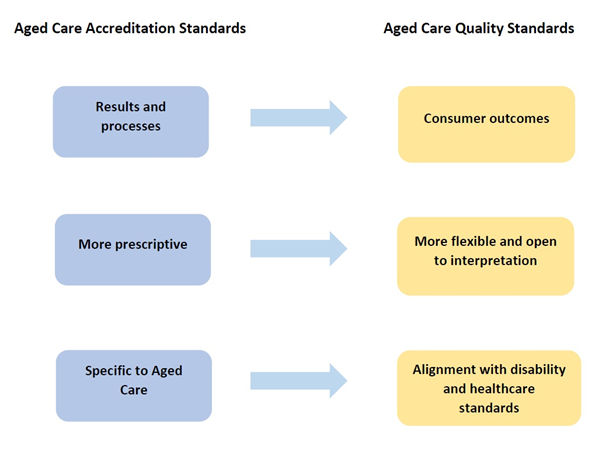
What's different?

  • The goal: the best possible outcome for each consumer – How the consumer experiences the organisation’s services underpins the new Standards. Do their needs, goals and preferences shape the care and services they receive? Do they feel welcomed, valued, and feel that they belong? These Standards emphasise tailored, individual person-centred care for each consumer.
     
  • Outcomes focus means that indicators are less prescriptive and more flexible – The Standards Guidance material highlights the flexible nature of the new Standards, and that they are open to interpretation depending on the type of services your organisation provides. Rather than provide a set of pre-defined focus areas, there is now the opportunity to consider how your service can best meet the required outcomes and the individual needs of consumers in a less prescriptive way. However, processes are still important! In mapping the new Standards into SPP, we have tried to strike a balance between providing useful guidance for the kinds of things to be considering, while still emphasising the focus on consumer outcomes.
     
  • Greater compatibility with other types of service standards such as health care and disability means that the Standards are more streamlined for organisations that need to meet more than one set of standards. This is also reflected in the mapping of the new Standards in SPP, which has greater cross-mapping with many other sets of standards (especially compared with the old Residential Aged Care standards).
     
  • Standard 1 Consumer Dignity and Choice emphasises that person-centred care underpins all the other standards, and should inform all aspects of care and services in your organisation.
     
  • Standard 8 Organisational Governance contains some important new requirements, including the implementation of a clinical governance framework (if applicable), and greater accountability for the governing body to oversee and be responsible for the safety and quality of services.

How to prepare for transition with SPP

  • Build awareness of the new Standards and guidance material
    • Consider how they will inform your organisation’s culture and practices
    • Ensure that the governing body leads and communicates the changes that are required
    • Talk to consumers and their families, and support them to understand the Standards
  • Self-assess and conduct a gap analysis
    The best way to understand the requirements of the new Standards is to undertake the relevant self-assessments in SPP.
    • If you have already self-assessed against either the Residential Aged Care or Home Care Standards in SPP, you will immediately be able to see where the gaps are between these and the new Aged Care Quality Standards.
    • If you are new to SPP, you can simply complete the self-assessments for the new Aged Care Quality standards. Where a requirement is not met, SPP will group together all your required actions into a ‘Standards Action Plan’, which can form the basis of your continuous improvement/transition plan.
  • Make a transition plan.
    This may include actions such as:
    • Reviewing existing systems or processes against best practice
    • Training staff and volunteers to build their knowledge and capabilities
    • Involving consumers, their families, staff and other relevant stakeholders in the transition process
  • Implement and monitor the transition plan.
    As you complete each action, you can view your progress against the Standards Action Plan, and the Standards Report in SPP.
    • Set realistic timeframes and goals for meeting specific actions in the transition plan
    • Monitor the implementation of the plan and whether you are on track for the 1 July 2019 assessment start date
    • Performance measurement against the new Standards needs to include systems to measure consumer outcomes – this is crucial to demonstrate that your organisation meets the new Standards!

Things to keep in mind

  • Although your organisation needs to be working towards full compliance by 1 July 2019, you also need to be prepared for an unannounced assessment against the existing standards while they are in effect until this date. This means maintaining your systems and documentation to show alignment with the current standards while you are transitioning to the new Standards.
     
  • The new Standards may raise the bar for consumer expectations and outcomes, however they are still considered to be the core minimum requirements for aged care – if achievable, organisations can (and should) go beyond these core requirements to provide a higher quality of care and services for consumers. This is where SPP is a valuable tool for continuous quality improvement, as it has detailed quizzes on many additional areas of quality and service delivery. 

Developing a Set of National Child Safe Standards

Last week, we provided a brief update on some of the current developments in child safe policy and principles, in light of the findings and recommendations of the Royal Commission into Institutional Responses to Child Sexual Abuse.

Included in the final report of the Royal Commission was the recommendation for a set of National Child Safe Standards, which would set out the key elements and indicators of a child safe institution.

The standards proposed by the Royal Commission are as follows.

Standard 1 – Child safety is embedded in institutional leadership, governance and culture.

Standard 2 – Children participate in decisions affecting them and are taken seriously.

Standard 3 – Families and communities are informed and involved.

Standard 4 – Equity is upheld and diverse needs are taken into account.

Standard 5 – People working with children are suitable and supported.

Standard 6 – Processes to respond to complaints of child sexual abuse are child focused.

Standard 7 – Staff are equipped with the knowledge, skills and awareness to keep children safe through continual education and training.

Standard 8 – Physical and online environments minimise the opportunity for abuse to occur.

Standard 9 – Implementation of the Child Safe Standards is continuously reviewed and improved.

Standard 10 – Policies and procedures document how the institution is child safe.

The Commission’s proposed standards have not been legislated yet, however they are an excellent reference point for organisations that are focussed on best practice in the delivery of child safe services. The standards are based on high-level principles and are intended to be understood holistically. So that they can be applicable to different types of organisations, they are outcomes-focused rather than having prescriptive processes for organisations to follow.

This is a great approach because it aims to develop organisational culture and not simply create more compliance requirements. It also allows organisations to be flexible in the way they achieve these outcomes, encouraging new ways to get children and their families involved in organisational processes and decision making.

To support organisations in implementing these standards, the core components of each of the standards have been detailed in Appendix A of Volume 6 of the final report.

> Download the Practical guidance for implementing the Child Safe Standards [PDF]

These standards have also been incorporated into a set of National Child Safe Principles, currently in draft stage of development by the Australian Human Rights Commission. It is expected that they will be signed off by the Council of Australian Governments (COAG) in July 2018.

SPP Updates in Child Safety

We have been closely following these developments in child safety policy, and have also recently revised the WA child protection standards: the Better Care, Better Services Standards, which came into force from 1 January 2018. Those standards incorporate many of the above principles, such as asking children about what their safety needs are and being responsive to those needs, and being able to demonstrate that children understand their right to feel safe.

To align our assessments in SPP with these updated principles for child safety, we have also amended and added questions to some of our child protection-related assessments. For more details on these changes and how they may affect your organisation, see the March update in the Reading Room.

BNG is committed to keeping up-to-date with policy and regulatory changes in child protection, and we will keep you informed of developments with the Child Safe Standards and Child Safe Principles.

How Child Safe is your organisation?

Last month, Emma from the BNG team attended the Mackillop Family Services conference, Child Safe Organisations: Prevention and Practice Beyond the Royal Commission, which was held in Melbourne.

It was a great opportunity to hear about the current developments in legislation and policy in light of the Royal Commission findings and recommendations, some of which are already in the process of being implemented.

Among the various discussions that came out of the conference, there were some key points relating to organisational practices that were raised. Many of these were centered around a child-rights approach to child safety, including:

  • The need to listen to children, and believe them, rather than dismissing them by saying ‘he/she always makes things up’ or ‘there’s no way that staff member would have done that’
  • Looking at organisations through the eyes of children. How do they perceive the structures in place that facilitate and support them to come forward and disclose abuse? Do they feel safe and comfortable to do so, and are there child-friendly mechanisms which support this?
  • Putting the best interests of children first, as well as taking into consideration their views and opinions
  • The importance of positive organisational cultures – cultures that promote a learning organisation and prioritise and promote child safety

It is essential that organisations strive toward best practice with the attitude of understanding why they are doing things, not only what they are doing. Making systems and processes child safe should not be seen as a burden, but as something that will improve services and outcomes as well as protect children from harm.

How can you ensure that children experience organisations as being child safe

From the recommendations of the Royal Commission, we have a better idea of where we need to be, but how do we get there? Many of these recommendations might seem difficult to aim for because they are not concrete, measurable outcomes, such as ‘culture change’.

Becoming a best practice child safe organisation is a long-term strategy, and will not happen overnight or by accident. Some suggestions for where to begin are:

  • Make child safety a standing item in board meetings, with child safety reported on and presented to the board on a quarterly basis
  • Boards and senior leadership should send out internal communications to staff and stakeholders clarifying their stance on child safety, and stating their renewed commitment as a result of the Royal Commission—including how these commitments will be demonstrated
  • Ensure the following are in place, are communicated, and are regularly reviewed and updated
    • Child Safe policy
    • An updated Code of Conduct with a child safe focus
    • Strategies to promote participation and empowerment of children, including tailored organisational documents that they have access to and can understand
    • Clear reporting procedures that comply with any relevant mandatory reporting requirements

SPP updates in child safety

We recently added into SPP the revised WA child protection standards, the Better Care, Better Services Standards, which came into effect from 1 January 2018.

These standards reflect many of the child rights-based principles outlined above, such as asking children about their safety needs and being responsive to their needs.

To align our assessments in SPP with these updated principles for child safety, we also amended and added questions in some of our child protection-related assessments. For more details on these changes and how they may affect your organisation, see the March Alert in the Reading Room.

If you found this post useful, look out for next week’s post, which will outline the developments towards a set of National Child Safe Standards.
The team at BNG is committed to supporting organisations strive for best practice and keeping you up-to-date with developments in the area of child protection. If you have a request or an idea for a resource that would benefit you and other organisations, please email us