Victorian social services framework- what is new?

As of the 1st of July 2024, the Victorian Social Services framework is now in effect, replacing the Victorian Human Service Standards and providing a cohesive regulatory framework for all registered social service providers in Victoria. 

The new Social Services Framework now also includes the introduction of the Social Services Regulator, which is an independent statutory authority established under the Social Services Regulation Act 2021 (Vic).

Jonathan Kaplan has been appointed as the inaugural Social Services Regulator. Within this role he is responsible for conducting several measures designed to support the safe delivery of social services including:

  • Ensuring service providers understand their role in protecting the rights of service users;
  • Defining roles and responsibilities of service providers;
  • Responding to risks of harm through monitoring and enforcement powers; and
  • Identifying and responding to any risks of harm to service users.

Victorian Social Services Standards

The new framework aims to both increase efficiency of the social service system by simplifying registration and reporting requirements for providers, and improve the safety of Victorian consumers who engage with the social service system.

To reflect this streamlining of the social services system, the new framework features six standards, which are as follows:  

  • Safe service delivery; 
  • Service user agency and dignity;  
  • Safe service environment;  
  • Feedback and complaints;  
  • Accountable organisational governance; and  
  • Safe workforce.  

The standards apply to a range of different providers in Victoria including:  

  • Out of home care services for children and young people;  
  • Community-based child and family services;  
  • Disability services provided or funded by the department, or funded by Transport Accident Commission or WorkSafe;  
  • Supported residential services; and  
  • Homelessness support services such as referral, support and accommodation services. 

The Regulator has recently issued guidance that includes suggested actions and success indicators for meeting the requirements of each service standard.

Victorian Child Safe Standards

In addition, the Regulator will now also oversee the Victorian Child Safe Standards, primarily focusing on informing and educating organisations about their obligations under these standards.   

However, in the case of more extreme circumstances, the Regulator is also able to take further regulatory action to ensure an organisation’s compliance with the Child Safe Standards and to address serious risks to the safety of children and young people. 

How SPP can help your organisation

To help providers ensure that they understand and comply with all of the requirements, recommended actions and indicators of success featured within the new Victorian Social Services Standards, we’ve built a self-assessment module in SPP that reflects this new framework.

And for providers who have been using our existing self-assessment moduleto follow the current Human Services Standards, we have a mapped self-assessment so that you can quickly compare the two sets of standards and identify any additional areas of work required.

In addition, we also have a separate self-assessment for the Victorian Child Safe Standards!

Ready to meet the new Victorian Social Services Framework?

Sign up to SPP to see how our self-assessments can help you with your social service compliance!

The Cosmetic Surgery Standards are now in place

As part of the national reform of the cosmetic surgery sector in Australia, the Australian Commission on Safety and Quality in Health Care (the Commission) developed and released the National Safety and Quality Cosmetic Surgery (NSQCS) Standards in December 2023. These aim to protect the public from harm and improve the quality of cosmetic surgery in Australia by mitigating risks relating to the delivery of clinical care within cosmetic surgery services.  

Who will the Standards affect?

These standards must be implemented by every service in Australia where cosmetic surgery is performed. The Commission has defined Cosmetic Surgery as an invasive surgical procedure that involves cutting beneath the skin (not injectables) for the purpose of achieving what a person perceives to be a more desirable appearance.

All services that offer these procedures, from small day procedure clinics to large health organisations, will be equally monitored against these standards. This does not include:

  • Non-surgical procedures that do not involve cutting beneath the skin (e.g. mole removal);  
  • Gender affirmation surgery; 
  • Surgery and procedures which may also lead to improvement in appearance; and 
  • Reconstructive surgery. 

The standards are aligned to the National Safety and Quality Health and Safety (NSQHS) Standards, which all hospitals and day procedure services (including services offering the above procedures) are required to follow. In addition to the NSQHS-aligned actions, there are also 20 actions specific to the delivery of cosmetic surgery that must be followed as part of the Cosmetic Surgery Standards. 

Organisations who already follow the NSQHS Standards may find it useful to use the Commission’s map of the NSQHS to NSQCS to guide their understanding of how the new requirements fit with their existing compliance.

What are the standards?

There are seven individual standards:  

  1. Clinical governance
  2. Partnering with consumers
  3. Preventing and controlling infection
  4. Medication safety
  5. Comprehensive care
  6. Communicating for safety
  7. Recognising and responding to acute deterioration

The first two standards, clinical governance and partnering with consumers, incorporate the clinical governance framework to establish the underlying requirements for services to effectively fulfill the subsequent standards. Each standard includes a consumer outcome statement, a statement of intent and then several items which are broken down into more detailed actions.  

Additional changes and reforms:

The standards have been curated to complement other reforms to the cosmetic surgery sector, including:  

  • legislative amendments to the requisite training required to acquire the title “surgeon”; 
  • changes to the national licensing framework for cosmetic surgery by the Commission; 
  • new guidelines enforced by the Medical Board of Australia (MBA) for conducting and advertising cosmetic surgery; and  
  • the introduction of a cosmetic surgery area of practice enforcement by the MBA.

For more information outlining these complementary reforms look here.

The Cosmetic Surgery Standards in SPP

To help you understand all these requirements and intended outcomeswe’ve built a new self-assessment in SPP for the Cosmetic Surgery Standards. 

This is in addition to our existing NSQHS self-assessments.

Need to comply with the Cosmetic Surgery Standards?

Sign up to SPP to ensure your organisation is meeting their new requirements!

Whistleblower Protection in the New Aged Care Act: do you have a Whistleblower policy?

In December 2023 the Department of Health and Aged Care released the exposure draft of the Bill for the new Aged Care Act, which is expected to be finalised in 2025.

The new Act will implement fundamental changes to the current Aged Care Act 1997 and the Aged Care Quality and Safety Commission Act 2018.

One of these changes includes new whistleblower protection requirements for aged care providers. Unlike the Aged Care Act, the new legislation will include specific provisions on Whistleblower Protection under the Information Management Chapter – including a requirement that all registered providers maintain a Whistleblower policy.

We’ve provided below an overview of the key Whistleblower Protection requirements under this legislation to help Aged Care providers prepare for their new obligations. 

What is Whistleblowing?

Whistleblowing is the intentional disclosure of information about wrongdoing or misconduct in an organisation, to the organisation itself, regulatory bodies, law enforcement or the media. Misconduct refers to illegal, improper or unethical conduct which is in breach of legislation, regulation or is generally fraudulent. 

A Whistleblower Protection program protects workers who wish to speak up about wrongdoings or misconduct.

What Qualifies as a Whistleblower Disclosure?

A disclosure qualifies for protection when the individual has reasonable grounds to believe their disclosure indicates an entity has contravened with the law. Under the proposed new Act, this disclosure can be made orally or in writing by an individual associated with the organisation to any of the following: 

  • A member of staff of the Aged Care Quality and Safety Commission (ACQSC);
  • The Secretary (or any other official) of the Department of Health and Aged Care;
  • The Australian Prudential Regulatory Authority (APRA);
  • The Australian Securities and Investment Commission (ASIC);
  • A police officer;
  • An officer, senior manager or auditor of the organisation; or
  • A person that the organisation has authorised to receive a disclosure (this can include a person external to the organisation).

What Protections does a Whistleblower have?

  • The individual is not subject to any civil, criminal or administrative liability for making their disclosure;
  • No contract or remedy may be enforced and no contractual or other right can be exercised against the individual on the basis of their disclosure; and
  • A contract that the individual is a party to cannot be terminated on the basis that their disclosure constitutes a breach of that contract.

So what does this mean for Aged Care Providers?

It is the aged care provider’s responsibility to implement a robust Whistleblower Protection policy for their organisation. This should include:

  • Nominating a qualified/ experienced Whistleblower Protection Officer;
  • Informing their staff of their rights to make protected whistleblower disclosures;
  • Ensuring aged care workers who make a disclosure are not victimised, and that their identity is kept confidential; and
  • Providing support and positive action for whistleblowers (for example, reallocation or a leave of absence while the matter is under investigation).

Most of these requirements are already mandatory under the Corporations Act 2001, while some details are also covered under Division 54 – Quality Care of the Aged Care Act 1997. Therefore, providers should already have some form of Whistleblower Protection policy in place. However, it is important to ensure these policies meet the more in depth requirements of the new Aged Care Act.

How SPP Can Help Your Organisation

To assist providers in preparing for these Whistleblower Protection requirements in the new Aged Care Act, we have these Whistleblower Protection resources:

  • Policy: Whistleblower Protection for public companies;
  • Policy: Whistleblower Protection for small organisations; and
  • Information Sheet: Whistleblower Protection.

All of the above resources can be found in our Reading Room by searching the keyword “whistleblower”.

Want to get a head start on Whistleblower compliance?

Sign up to SPP to access our Whistleblower resources!

DRC: Support Coordination

The Final Report from the Royal Commission into Violence, Abuse, Neglect and Exploitation of People with Disability (DRC) acknowledged the very important role that support coordination plays for participants, particularly those who are at risk. Support coordination is essential to ensuring that participants can exercise proper choice and control over their life and the supports they receive.

However, the DRC did raise some concerns about the current responsibilities of support coordinators, the conflict of interest risks, and the quality and consistency of the services being provided.  

Roles and responsibilities of a support coordinator

The DRC reiterated the role of support coordination supports being to assist NDIS participants in connecting with other funded supports. Support coordinators are also expected to build participant capacity and capability to understand plans, navigate the NDIS and exercise choice and control. The DRC added that support coordination services are required to broker arrangements between participants and providers in line with the participant’s wishes and budget and ensure that the participant is receiving services which represent value.

Under the current NDIS Rules, support coordinators are required to ‘act with integrity, honesty and transparency’, as laid out in the Code of Conduct. The National Disability Insurance Agency (NDIA) further clarified this requirement, stating that to comply with the Code of Conduct’s requirements, support coordinators must:

  • recommend and provide supports and services appropriate to the needs of the participant;
  • maintain integrity by declaring and avoiding any real or perceived conflicts of interest; and
  • avoid engaging in, participating in, or promoting sharp practices.

Conflict of interest

Conflict of interest in relation to support coordination was identified as an issue in the Tune Review, the NDIS Review and now the Royal Commission. The DRC agreed with the NDIA’s position that it is not appropriate for providers to deliver coordination services as well as regular supports to the same participant. Recommendation 10.2 suggests that the NDIS Rules be changed to make it clear that support coordination and other funded supports should be delivered by separate providers. Recommendation 10.2 acknowledges that in some cases the separation of support coordination from other funded supports is not possible, and recommended there be some limited exceptions where it is acceptable for the one provider to be providing both support coordination and supports, such as in rural or culturally and linguistically diverse communities.

Quality of support coordination

The DRC’s investigation of support coordination providers found considerable variation in quality between individual support coordinators. Common complaints from DRC hearings included:

  • lack of accountability,
  • little or no contact with participants, and
  • a lack of understanding about the services available to participants.

Recommendation 10.4 suggested that the NDIS Quality and Safeguards Commission should examine the quality of support coordination services.

The DRC raised concerns for participants, particularly those who are at risk of violence, abuse, neglect and exploitation if their support coordinators are not at a quality consistent with the expectations of the NDIA or the Commission.

The DRC discussed the need for better training and monitoring for support coordinators, including the addition of new modules to the Workforce Capability Framework. This was reinforced in Volume 8 of the DRC’s Final Report, which went into detail about the need for better training of support coordinators providing services to participants who are navigating the legal system.

Expansion of support coordination funding

The DRC recommended that more funding for support coordination in participant plans is needed to address risks and ensure participants receive adequate supports. The Final Report called on the NDIA to ensure that all participants who are identified as being at higher risk of violence, abuse, neglect or exploitation, particularly those in supported accommodation, receive funding to access support coordination services.  

How BNG can help

We have several templates which may be helpful in the delivery of high quality and transparent support coordination, including:

  • Policy: Support Coordination and Plan Management;
  • Policy: Conflict of Interest;
  • Template: Conflict of Interest Register; and
  • Template: NDIS Service Agreement.

Help with support coordination?

To see our support coordination resources, and hundreds more, take out a trial!

An Introduction to the Clinical Care Standards

What are the Clinical Care Standards?

The Clinical Care Standards are a group of 17 evidence-based quality statements that address the expected level of care and outcomes when managing specific health conditions.

They include guidance for both clinicians and health service organisations, and also include expectations for consumers receiving the relevant type of care. Each Standard includes a set of indicators that can be used by health service organisations to support implementation, monitoring and identify areas for improvement.

The aim of the Standards is to set out a baseline standard of care for the delivery of clinical care wherever this care is being provided, and to reduce variation in care outcomes. Broad implementation of the Standards should ensure that:

  • Patients understand the care they’ll be receiving in order for them to make informed decisions;
  • Clinicians and healthcare professionals understand current best practice, and use this to inform their care delivery; and
  • Health service organisations understand how to best support their clinicians and monitor the level of care their patients are receiving.

The National Safety and Quality Health Service (NSQHS) Standards, which must be followed by all public and private hospitals, day procedure services and public dental practices, include actions that support or require the implementation of the Clinical Care Standards.

Who should follow the Standards?

Two of the Clinical Care Standards, Antimicrobial Stewardship and Delirium, are explicitly referenced under Action 3.18 and Action 5.29 respectively of the NSQHS Standards. Compliance with the requirements of these Standards therefore forms a part of mandatory NQSHS compliance for health service organisations.

Advisory AS18/12 also mandates the Colonoscopy Clinical Care Standard for any health service organisation that provides colonoscopy services under Actions 1.23, 1.24, 1.27b, and 1.28a of the NSQHS Standards.

Following the Clinical Care Standards that are relevant to your service is strongly encouraged as best practice, as it supports improved outcomes for patients.  An evaluation report of the impact of the Clinical Care Standards on patient outcomes revealed that 92% of health organisations surveyed who had implemented one of the Standards reported that it improved the quality of care delivered to patients in that care area. Secondary health data sources relating to the Antimicrobial Stewardship, Delirium and Hip Fracture Standards demonstrate a correlation between the release of each Standard and improved outcomes in the respective areas.

Implementation of relevant Clinical Care Standards can help organisations meet their obligations under the NSQHS Standards, in particular Actions 1.01c, 1.27b, and 1.28.

Which clinical care areas are covered?

The following areas have a specific clinical care standard:

  • Acute Anaphylaxis;
  • Acute Coronary Syndromes;
  • Acute Stroke;
  • Antimicrobial Stewardship;
  • Cataract;
  • Colonoscopy;
  • Delirium;
  • Heavy Menstrual Bleeding;
  • Hip Fracture Care;
  • Low Back Pain;
  • Management of Peripheral Intravenous Catheters;
  • Opioid Analgesic Stewardship in acute pain;
  • Osteoarthritis of the Knee;
  • Sepsis;
  • Stillbirth;
  • Third and Fourth Degree Perineal Tears; and
  • Venous Thromboembolism Prevention.

In addition, the Australian Commission on Safety and Quality in Health Care is developing two new Clinical Care Standards, covering Chronic Obstructive Pulmonary Disease and Psychotropic Medicines in Cognitive Disability or Impairment. The Acute Stroke, Heavy Menstrual Bleeding, Osteoarthritis of the Knee, and Colonoscopy Standards are under review.

The Clinical Care Standards in SPP

A number of our health service clients asked us to look at developing self-assessments to implement some of the Clinical Care Standards. So we’ve worked with them to build one for the Antimicrobial Stewardship Clinical Care Standard, which is now available in SPP.

A self-assessment for the Delirium Clinical Care Standard is on the way next, so make sure to keep an eye out for it!

Organisations can use the results from completing each Clinical Care Standard as evidence to support their compliance against their NSQHS requirements.

If there’s a particular Clinical Care Standard you’d be interested in accessing as a self-assessment, we’d be keen to hear from you – just let us know!

Are you up to date with your NSQHS compliance?

Sign up to SPP to check how your organisation performs against the NSQHS Framework.

Evidence-based Care in Aged Care 

The recent publication of a research study by the Australian Institute of Health Innovation highlighted some major areas of concern in the aged care sector. The study focused on the level of adherence to evidence-based care in aged care across 14 different care areas.

What is evidence-based care?

Evidence-based care (or evidence-based practice) involves integrating up-to-date, best practice research with clinical knowledge and experience, and the preferences of the older person. As research and knowledge about a specific clinical care area evolves, an organisation should be reviewing their own processes to ensure that they’re still delivering care that best addresses the needs of older people. Organisations should also ensure that they have effective processes to integrate new or revised evidence into the way they deliver services.

Some factors that may contribute to a person not receiving evidence-based care include: 

  • When an organisation doesn’t regularly check for the latest developments in clinical care areas; 
  • Using outdated, not well supported, or contraindicated evidence as a basis for care;  
  • Failing to adapt care practices to the needs of each older person based on their preferences; and  
  • Failing to implement practices that are based on the latest available evidence. 

Evidence-based care in standards

The requirement to deliver evidence-based care is included in both the National Safety and Quality Health Service Standards (NSQHS) and the strengthened Aged Care Quality Standards (ACQS). Findings of the Aged Care Royal Commission recommended that:

The aged care system should adopt evidence-based and continuous improvement strategies to allow for transparent measurement and reporting of the quality of care being delivered to older people.

Evidence-based (or “evidence-informed”) practice is also a quality indicator of a number of the NDIS Practice Standards, such as those for: 

  • Quality Management; 
  • Responsive Support Provision; and 
  • Behaviour Support.

The Findings of the Research Study

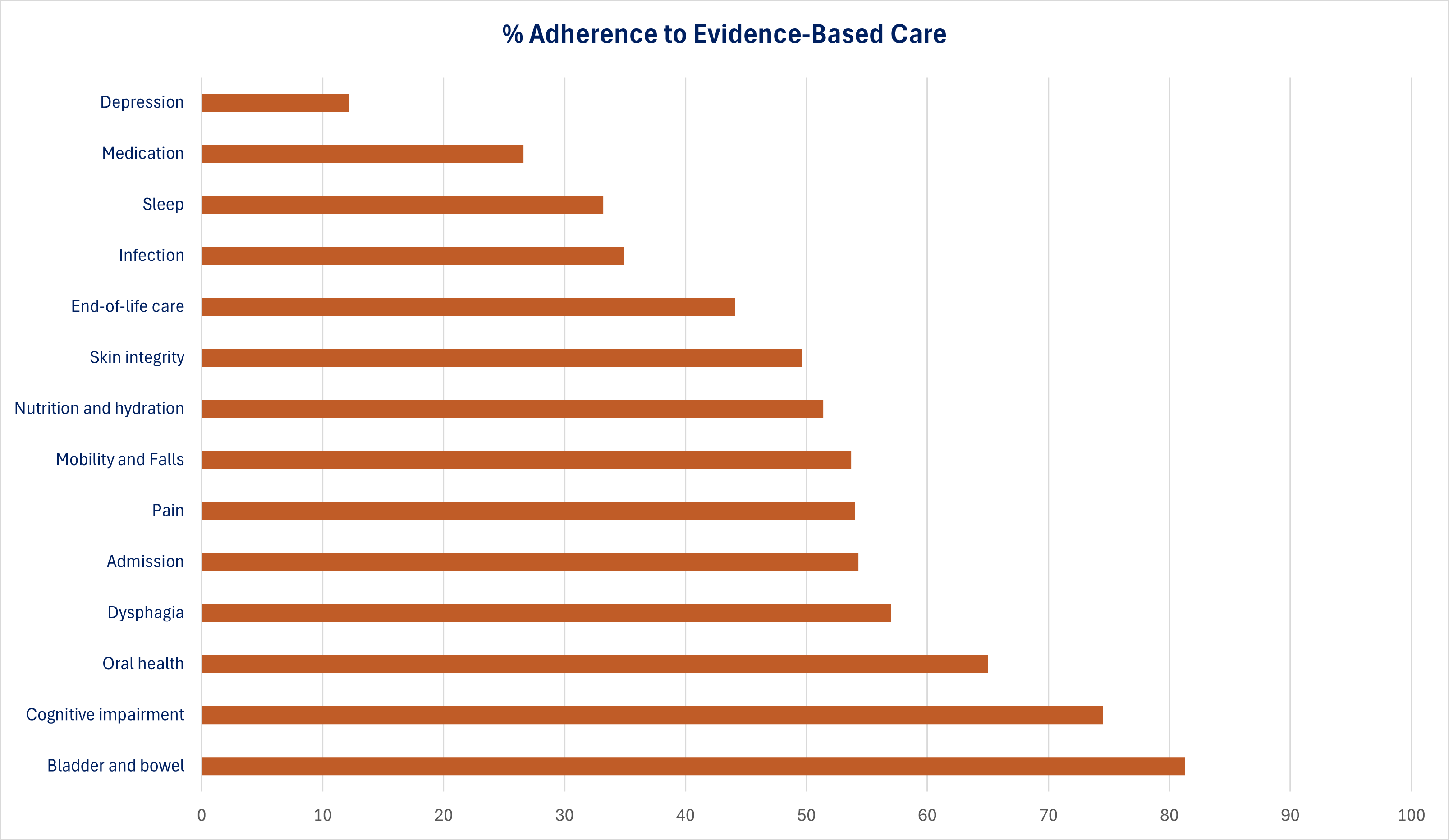
The findings demonstrate that, while some areas of care have relatively high levels of adherence to an evidence-based approach to care, there are also areas that are shockingly low.

On average, the adherence rate across all indicators studied was just over half (53.2%), with a high of 81.3% for continence care, and a low of 12.2% for mental health/depression related care.

Data from Australian Institute of Health Innovation (2024)

Some of these findings match recent results of the Residential Aged Care Quality Indicators from July-September 2023.

Some improvement opportunities

One area of concern is the low adherence to evidence-based practices in medication management, given the high prevalence of polypharmacy in aged care residents, with over a third of aged care residents prescribed nine or more medications.

Another area for improvement is in falls management, where the current ‘best practice’ guidelines date back to 2009. Despite a relatively higher adherence rate to evidence-based care, the trend in falls has remained steady over the past few years, with nearly a third of aged care residents experiencing a fall each quarter during that period. The steady trend reflects the need for continued work to improve knowledge and understanding of clinical care areas in order to aid improvement. New research has informed draft Updated Fall Prevention Guidelines for Residential Aged Care Services, which are currently in a consultation phase. Looking forward,  hopefully the updated guidelines will drive an improvement in fall prevention when they are released, and provide a useful resource for organisations to review their falls management processes and procedures.

A statistically significant area in the recent Quality Indicators that supports the importance of evidence-based care is in continence care. Of the aged care residents who were assessed, 78% were recorded with incontinence, however, only 4% of residents were recorded as having incontinence-associated dermatitis. This indicates that the high level of adherence to evidence-based care in this area is resulting in better outcomes for older people, drastically reducing their likelihood of experiencing incontinence-related issues.

Where to for providers?

This is an opportunity for providers to reflect on their own approach to evidence-based care and practices, especially in the areas of low adherence identified in the research study. In addition, Outcome 5.5 (Clinical Safety) of the Strengthened Aged Care Quality Standards goes into greater detail about many of these areas of care. More specific requirements surrounding specific clinical care areas should act as a tool to guide organisations in providing the level of care older people require.

The Australian Commission on Safety and Quality in Healthcare has some guidance for supporting evidence-based practice, while the NDIS Quality and Safeguards Commission has released their Evidence-Informed Practice Guide, which is a helpful resource to help you consider improvements to processes and procedures.  

BNG and improving care

For further assistance, we have up-to-date policies for many of the areas of care evaluated in the research study, including: 

  • Policy: Promoting Emotional Wellbeing in Aged Care 
  • Policy: Oral Health 
  • Policy: Nutrition, Meals and Hydration
  • Policy: Continence Management
  • Policy: Falls Prevention
  • Policy: Pain Management 
  • Policy: Pressure Injuries
  • Policy: Clinical Deterioration 
  • Policy: End of Life Care and Palliative Care 

In addition, we have information sheets for some topics that provide more in-depth information in areas such as: 

  • Emotional Wellbeing in Aged Care 
  • Nutrition, Meals and Hydration 

Need a refresh on clinical care areas?

Sign up to SPP to access helpful resources to improve your organisation’s care processes!

DRC: Human Rights

Upholding the human rights of participants is a common theme that underpins the discussion and Recommendations published by the Disability Royal Commission (DRC). Whilst most of the human rights Recommendations are directed at the federal, state and territory governments, several Recommendations are related to human rights requirements for providers.

The United Nations’ Convention on the Rights of People with Disability (CRPD) is the foundation of the DRC’s investigation into the human rights of people with disability. The CRPD lays out Australia’s obligations in relation to the human rights of people with disability. There are eight guiding human rights principles that underlie the CRPD (the Human Rights Principles), as follows:

  1. Respect for inherent dignity, individual autonomy (including the freedom to make one’s own choices), and independence of persons;
  2. Non-discrimination;
  3. Full and effective participation and inclusion in society;
  4. Respect for difference and acceptance of persons with disabilities as part of human diversity and humanity;
  5. Equality of opportunity;
  6. Accessibility;
  7. Equality between men and women; and
  8. Respect for the evolving capacities of children with disabilities and respect for the right of children with disabilities to preserve their identities.

The DRC found that the above Human Rights Principles were not adequately protected and upheld under Australian law or policy and practice.

The DRC's key human rights Recommendations

Recommendation 10.1 of the DRC final report suggests that the NDIS Quality and Safeguards Commission should develop a program to ensure that human rights are embedded in the design and delivery of each NDIS Provider’s services. The specifics of the program are not clear, however the final report suggests that the program will give regulators oversight of providers’ implementation of human rights policies and procedures.

Accompanying Recommendation 10.1 are several recommendations from Volume 4: Realising the human rights of people with disability. These Recommendations endorse the enactment of a disability rights act, which would enshrine the human rights of people with disability in Australian law.

The DRC made a distinction between actual and potential impacts on the human rights of people with disability.

Potential impacts

Potential impacts include identified risks to the legal and human rights of people with disability. Potential impacts should be identified and addressed before they happen. This can be dealt with through an organisation’s risk management system.

Actual Impacts

Actual impacts on human rights include breaches of a person’s human rights which have already happened. Addressing actual impacts may require remediation and should be dealt with as a priority.

Embedding human rights in service provision

Implementing policies and procedures related to human rights is an essential first step that NDIS Providers should take to stay ahead of new requirements stemming from the DRC. Implementation should include:

  • Assigning responsibility
    Ensure that responsibility for the organisation’s human rights impacts is assigned to a senior staff member or a committee.
  • Training
    The workforce should be made aware of their responsibilities in relation to human rights, and understand how they can ensure human rights are being upheld.
  • Assessment
    Assessing the organisation’s services and identifying the potential human rights impacts will help the organisation to prevent potential impacts from becoming actual impacts.
  • Monitoring and review
    The organisation should regularly review its performance in relation to human rights. Any breaches or impacts should be addressed as soon as possible.
  • Complaints and grievances
    Complaints, feedback and grievances in relation to human rights impacts should be taken very seriously and investigated as soon as possible by the organisation.

How BNG can help

We have developed a new Human Rights policy template to help providers stay on the front foot in relation to human rights. The policy template will help you understand the central principles of the CRPD and embed human rights in service delivery.

This blog post is the third in our series of posts on the Disability Royal Commission. You can see the other blog posts in the series here.

Need a human rights policy?

For access to our human rights policy and hundreds of other templates, sign up for SPP.

The 10 most common complaints in residential Aged Care

The Aged Care Quality and Safety Commission recently released their first annual report regarding the common complaints received about aged care services. Complaints and feedback play a central role in the quality improvement process, as they can highlight issues of concern that care recipients may have.  Understanding the problem areas of other providers can help to inform your own quality improvement.

In total there were 9,198 complaints submitted to the Commission from July 2022 to June 2023. The Commission identified 10 main complaint categories in residential aged care. These categories provide some insight into the most common issues faced by service users, and will help providers to identify the processes which they could review as part of their continuous improvement system.

As we go through these main complaint categories, we will note resources that we’ve developed which will help providers ensure that they are working to best practice in these areas. If you already have policies and procedures to address these processes, it might still be helpful to review them and compare them with ours.

Common complaint categories for residential aged care:

  • Medication administration and management
    Medication management accounted for 5.5% of complaints received by the Commission. Concerns included issues such as medications being delivered late, identification of patients and medicines, and medications not being started.
    SPP resources
    • Policy: Medication Management
  • Personal and oral hygiene
    Personal care was identified as a problem area for residential aged care providers, with 5.3% of complaints. Personal care includes things such as showering, bathing, and oral hygiene.
    SPP resources
    • Policy: Showering and Bathing
    • Policy: Oral Health (Aged Care)
  • Personnel number/proficiency
    Accounting for 4.8% of complaints about residential aged care, personnel play an essential role in the delivery of safe and quality services. Providers should focus on human resources issues such as recruitment, training, retention, and conditions.
    SPP resources
    • Policy: Employment Conditions
    • Policy: Staff Recruitment
    • Policy: Key Personnel
    • + many more human resources
  • Consultation and communication with family/representatives
    Lack of communication with family and representatives made up 4.4% of residential aged care complaints in the last year. Engagement with family and representatives is important in ensuring that service users are receiving adequate care and services.
    SPP resources
    • Policy: Partnering with Consumers
    • Template: Consumer Advisory Body Terms of Reference
  • Falls prevention
    While falls prevention and post fall management made up only a small portion of the complaints made to the Commission, these areas present a serious risk for providers.
    SPP resources
    • Policy: Falls Prevention (Aged Care)
    • Policy: Showering and Bathing
  • Food and catering
    Quality and variety of food and catering in residential aged care have received increased focus from the Commission recently. And the new Standard 6 (Food and Nutrition) in the Strengthened Quality Standards, currently being piloted, is dedicated to this area. Providers should implement processes to ensure that meals, drinks and snacks are co-designed, nutritious, and varied.
    SPP resources
    • Policy: Nutrition, Meals and Hydration (Aged Care)
    • Template: Mealtime Management Plan
  • Client assessment and service implementation
    Complaints pointed to service implementation and client assessment as areas which providers should review. Client assessments should not only occur at the beginning of service delivery, but should be a regular and ongoing process.
    SPP resources
    • Policy: Client Assessment and Review
    • Template: Client Risk Assessment
  • Consultation and communication
    Communication was another area identified in the Commission’s report as a problem area. With increased focus now on co-design, supported decision-making and consumer advisory bodies, providers should be implementing best practice communication processes.
    SPP resources
    • Policy: Supported Decision-Making and Dignity of Risk
    • Template: Consumer Advisory Body Terms of Reference
  • Physical environment
    Lack of cleanliness in the physical environment was a common complaint received by the Commission from residential aged care service users. Cleanliness is important in upholding the dignity of service users, and infection prevention and control.
    SPP resources:
    • Policy: Hospitality Services
  • Constipation and continence management
    Constipation and continence management accounted for 2.8% of residential aged care related complaints. Though only a small number of complaints were made about these issues, proper management of these areas is essential in providing quality and safe care to service users.
    SPP resources:
    • Policy: Continence Management (Aged Care)

Take this opportunity to review your policies and procedures

The Commission’s new report is a great prompt for providers to consider the identified areas of common complaint as part of their continuous improvement activities.  Ask yourself the following questions regarding each area, to help you determine whether your current procedures could be improved:

  • What complaints and other feedback have we received in each of these areas?
  • What is working well?
  • Are our procedures consistently followed by all workers?
  • Are there improvements we could make?
  • Do we need to update our policies as a result?
  • If so, have we clearly communicated our revised procedures to all workers?

Interested in our resources?

Take a trial to see our best practice policies and procedures.

DRC: Supported Decision-Making

Continuing our blog post series on the Disability Royal Commission’s Final Report, today we look at supported decision-making. This topic is a strong focus of Volume 6: Enabling autonomy and access, and reflects findings from several Public Hearings including Public Hearing 30 and Public Hearing 32. The recommendations target a move away from substitute decision-making in favour of supporting participants to make their own decisions wherever possible, increasing participant autonomy. 

The recommendations centre around legislative protections for supported decision-making, particularly advocating for the following supported decision-making principles in Recommendation 6.6: 

  • Principle 1 – Recognition of the equal right to make decisions  
  • Principle 2 – Presumption of decision-making ability 
  • Principle 3 – Respect for dignity and dignity of risk 
  • Principle 4 – Recognition of informal supporters and advocates 
  • Principle 5 – Access to support  
  • Principle 6 – Decisions directed by will and preferences 
  • Principle 7 – Inclusion of safeguards 
  • Principle 8 – Co-designed processes 
  • Principle 9 – Recognition of diversity 
  • Principle 10 – Cultural safety 

While the principles in their entirety haven’t yet been codified or integrated into the Practice Standards, they do act as guidance for best practice decision-making processes for providers. At present, there is some inconsistency between jurisdictions regarding the protections and approach to decision-making rights and capability. Some jurisdictions already have aspects of these principles in their existing legislation, whereas others do not.  

Implementation of the Recommendations of the DRC would therefore mean people with disability would maintain the same rights when it comes to making their own decisions regardless of where they live in Australia.  

Principle 1 - Recognition of the equal right to make decisions

The first principle affirms that every person has an equal right to make decisions. People living with disability should not be excluded from making decisions about their lives. Recognising this principle is central to the concept of supported decision-making, as it places the person at the centre of their own care, with support to exercise their right to make decisions, rather than others making decisions for them. 

Principle 2 – Presumption of decision-making ability

This principle sets out a base line assumption that everyone is capable of making their own decisions. A person should never be treated as if they’re incapable of making decisions – an inability to make a decision on one topic or area does not exclude a person from making other decisions. Having a disability cannot be the sole justification for determining that someone does not have decision-making ability. Instead, that assessment should be made based on the specific and unique circumstances of the decision being made and the person’s understanding of that decision and its consequences. A person’s disability should only be relevant in assessments where that disability impacts their ability to make or carry out decisions, and should never be an automatic exclusionary factor.  

Recommendation 6.7 focuses further on decision-making ability, endorsing legislative changes that change how capacity (or capability) assessments are undertaken, with the starting point for these assessments being an assumption that a person is capable, moving the burden of proof to those seeking to prove incapability, rather than the added burden on people with disability to prove that they are capable.  

Principle 3 – Respect for dignity and dignity of risk

A major part of the ability to make decisions is the right to make decisions that involve some level of risk. Where a person with disability understands the potential risks involved in making a decision, but elects to make that decision anyway, they should be able to make that choice in the same way any other person is allowed to. Supported decision-making processes should help people with disability to understand the potential risks involved in their decisions, and advise, but should not actively discourage particular choices simply because there may be a level of risk to the participant.  

Principle 4 – Recognition of informal supporters and advocates

This principle highlights the important role of informal supporters, advocates and the support network for people living with disability. In addition to formally recognised roles, where a person or group may be legally recognised as a supporter, others involved in a person’s life or care may also participate in the supported decision-making process.  

Principle 4 advocates that people in these categories should be acknowledged and respected. Strong informal support relationships may help avoid reliance on more complex formal supported decision-making arrangements, and avoid substituted decision-making. The involvement of people whom a participant knows and trusts may make it easier to convey support in a more tailored manner, and more effectively achieve positive outcomes. 

Principle 5 – Access to support

Whose responsibility is it to provide information to people requiring support? Recommendation 6.13 is that public advocates and public guardians should provide “information, education and training on supported decision-making to people requiring supported decision-making and their families, private supporters and representatives (present or prospective), disability service providers, public agencies, the judiciary, tribunal members and legal representatives”.  

The wide scope of this recommendation both highlights access to information as an integral aspect of decision-making, and indicates supported decision-making as best practice even outside support services.  

For providers, information and education may include accessibility aids such as Easy English or interpreted resources to help participants understand their rights, the decision-making process, and potential outcomes from each decision. These types of aids may also be useful additions for other areas of focus in the principles, particularly Principles 9 and 10 which focus on diversity and cultural safety. 

Principle 6 – Decisions directed by will and preferences

The DRC report asserts that “a principled approach to supported decision-making requires a person’s stated or perceived ‘will and preferences’ to be at the centre of decision-making“.  

This principle directs that, just as those without a disability are not required to rationalise their decisions or prove that their choice is in their best interests, people with disability should have the same rights to make decisions about their own life, even where the decision may not be the ‘best’ option.  

It’s important to understand that the will and preferences of an individual are those expressed or indicated by that individual, and this is not the same thing as an organisation’s view of what is in the ‘best interests’ of that person.  The ‘best interests’ approach should not be used, as it can override the choice of a participant, and take away their autonomy and right to dignity of risk.  

For situations where a participant may be unable to express their will or preferences, for example where they are medically incapable, non-verbal, or there is limited access to communication aids, processes should be in place to refer to what they want or would want, for example using care plans to record their choices in advance, using a care record to determine a pattern of choices they’ve made in previous situations, and their feedback about their care in those situations, or involving trusted support persons who can provide insight into what they would want.  

Principle 7 – Inclusion of safeguards

People living with disability may be at greater risk of abuse or undue influence when making decisions. Principle 7 highlights the importance of safeguards in supported decision-making processes, in recognition of the potential imbalance of power between participants and their supporters/representatives.  

Recommendations connected to the inclusion of safeguards include: 

  • Recommendation 6.9, which recommends decision-making representatives as a last resort and strict guidelines on represented decisions to protect the autonomy of participants, and  
  • Recommendations 6.35 and 6.36, concerning the elimination of restrictive practices, including as a method of coercion or to influence the behaviour of a person with disability.  

Principle 8 – Co-designed processes

Processes for supported decision-making should be designed with the input of various stakeholders who will be able to provide insight into their requirements for supported decision-making policies and procedures. That way, people with disability have the opportunity to share their lived experience, and how different approaches may impact their lives.  

Principle 8 specifically highlights the involvement of people with cognitive disability, their supporters and representative organisations in co-design, however best practice could also include the involvement of staff, and ensuring the group of people consulted reflects the diversity of the organisation and recipients of care. On an individual level, participants should also be given the opportunity to co-design their own experience with decision-making. 

Co-designing these systems should also be a continuous process. As the demographics of your organisation change, so too do the needs of participants.  So, feedback, complaints and consultation processes become a vital part of identifying areas of improvement, to ensure that the organisation’s supported decision-making processes still meet the needs of participants.

Principle 9 – Recognition of diversity

Principle 9 focuses on ensuring the diverse experiences, identities and needs of people with disability are considered and recognised. It is connected to Principle 10 (Cultural safety), but focuses more on the individual’s specific background, and how their varying needs and experiences intersect with one another.  

The principle recognises differing approaches may be necessary for different participants. Therefore, a flexible and adaptable approach to decision-making should be adopted for organisations to best respond to the diverse needs of their participants.  

Organisations should consider how they can tailor their existing processes to meet the different needs of each individual with disability.  For example, by giving participants with cognitive disability more time to make decisions so they can consider them in another environment, or access support to understand their decision options. Recommendations 6.1, 6.2 and 6.3 all connect to this principle, regarding the need for increased accessibility in information, resources and communication, particularly relating to Auslan interpreters, and access to interpreters more generally.  

Also included in this principle are mental health and trauma-informed care considerations, recognising that people with disability who are affected by mental health or have experienced trauma may require different support.  

Principle 10 – Cultural safety

Principle 10 places focus on First Nations people and culturally and linguistically diverse people with disability. In addition to addressing the diversity requirements of Principle 9, organisations should also evaluate the cultural safety and suitability of the service environment.  

Public Hearing 30 raised questions about the ways in which a person’s culture may impact their decision-making ability, and also how culture can act as a support in the decision-making process. Organisations should ensure that their supported decision-making processes and service environment are culturally safe, and sensitive to the cultural needs of each participant, maintaining connections to culture and community.  

One way for organisations to improve their cultural safety is by collaborating and connecting with local cultural organisations. Having an established network may support organisations by providing advice on culturally appropriate supported decision-making strategies, as well as providing access to people within a person’s cultural community who may act as informal supporters for that person when making decisions. 

Where to next?

Most of the reforms in the DRC recommendations are targeted at government level rather than provider level, but they do also indicate the direction of best practice for providers and possible next steps for reform.  

Current reform work in the Aged Care sector also has supported decision-making as a focus, reflecting a broad cross-sector scope and changing attitudes to decision-making. Recommendation 10.6 would codify supported decision-making in the National Disability Insurance Scheme (Quality Indicators for NDIS Practice Standards) Guidelines 2018 (Cth), codifying specific actions for providers.  

To aid providers in actioning their supported decision-making requirements, Recommendation 10.7 endorses a co-designed practice guide on supported decision-making for service providers that is consistent with the decision-making principles.  

Supported Decision-Making and SPP

In line with the increased focus on supported decision-making in both the DRC recommendations and the Aged Care sector, we’ve recently updated and expanded on our supported decision-making resources, including: 

  • Info: Supported Decision-Making (Easy English) 
  • Policy: Supported Decision-Making and Dignity of Risk 
  • Policy: Supported Decision-Making and Dignity of Risk (NDIS) 

Our Easy English resource in particular may be useful for providers to improve their communication around supported decision-making, particularly for providing information to those with increased communication barriers. 

Catch up on our previous DRC blog post entries:

Need support for your Supported Decision-Making processes?

Sign up to SPP and let our resources guide you towards achieving best practice disability processes!